


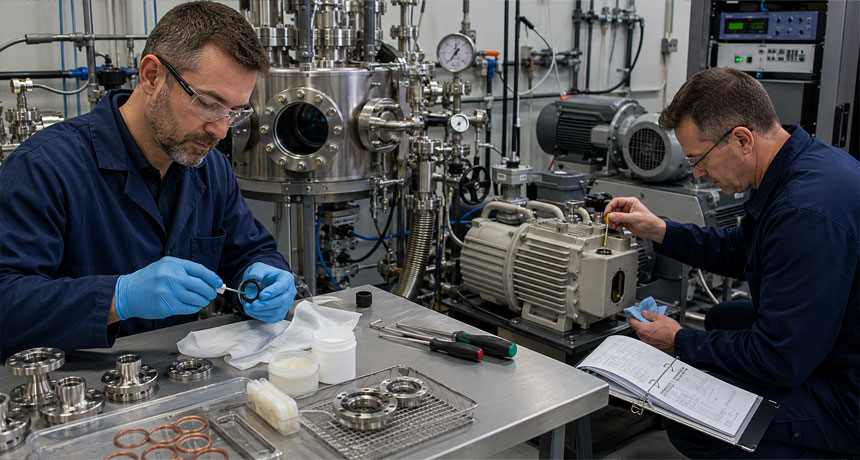
Proper Lubrication Techniques for Vacuum Components
Lubrication can improve the operation and service life of certain vacuum components, but it must be approached differently than lubrication in ordinary mechanical equipment. In a vacuum environment, excess grease or the wrong oil does more than create a mess. It can add gas load, migrate through the system, collect particles, contaminate sensitive surfaces, damage elastomers, or prevent the chamber from reaching its target pressure.
The first rule is that not every vacuum component should be lubricated. Some O-rings benefit from a very light film of grease, while others seal properly when installed clean and dry. Oil-sealed vacuum pumps require a specific fluid for lubrication, sealing, and heat transfer, but dry pumps are designed to keep lubricant out of the process chamber. Metal gaskets, CF knife edges, and many high-vacuum surfaces should not be greased at all.
Proper lubrication therefore begins with identifying the component, understanding its operating environment, and following the equipment manufacturer’s instructions. High Vac Depot’s guide to using grease in a vacuum system provides a useful foundation for this approach.
Understand what the lubricant is supposed to do
Vacuum lubricants can serve several purposes. They may reduce friction in a moving seal, help an O-ring seat without twisting, protect a component from corrosion, lubricate pump bearings and vanes, or provide temporary sealing assistance in a serviceable joint. The correct product and application method depend on which of these functions is required.
Lubrication should never be used as a substitute for sound mechanical condition. Grease will not permanently repair a scratched flange, damaged O-ring, distorted sealing groove, worn valve seat, or cracked component. Applying more lubricant to a questionable joint may temporarily change its behavior, but it can also hide the real problem and contaminate adjacent hardware.
Before lubricating anything, determine whether the component manufacturer recommends lubrication and whether the part is static or moving. A static O-ring may need little or no grease. A dynamic shaft seal or valve mechanism may require a specific lubricant to prevent wear. A vacuum pump may depend on a carefully selected oil formulation that cannot be replaced with a generic industrial oil.
Select a vacuum-compatible lubricant
Ordinary automotive, machine, or plumbing grease should not be introduced into a vacuum system. General-purpose lubricants may have relatively high vapor pressures, contain volatile additives, or react poorly with process gases and sealing materials. Under vacuum, those compounds can evaporate or migrate into the chamber.
Choose a lubricant with a sufficiently low vapor pressure for the intended operating range. The broader selection of vacuum greases, waxes, and sealants includes formulations intended for different pressure ranges, temperatures, materials, and chemical environments.
Base chemistry matters. Silicone-based vacuum greases are commonly used for general laboratory work, but they can be difficult to remove and may be unsuitable where silicone contamination affects a process. Hydrocarbon-based greases can offer strong high-vacuum performance, but they are not appropriate for every reactive or oxygen-rich environment. PFPE-based lubricants may be selected for chemically aggressive or oxidizing applications, but only when the formulation is explicitly approved for the equipment and process.
Compatibility should be verified with:
- The expected vacuum level
- Minimum and maximum operating temperature
- O-ring or seal material
- Process gases and vapors
- Substrate or product sensitivity
- Cleaning solvents and maintenance procedures
- The component manufacturer’s requirements
Never mix greases simply because both products are labeled for vacuum service. Different base chemistries may be incompatible, and residue from the old lubricant can change the behavior of the new one.
Lubricating vacuum O-rings correctly
O-rings are among the components most commonly over-lubricated. In many static vacuum seals, grease is not what creates the seal. The seal is produced by controlled compression of an undamaged O-ring against clean, properly designed mating surfaces. High Vac Depot’s discussion of O-ring seal design explains why material selection, compression, temperature, and sealing geometry remain more important than lubricant quantity.
Before lubricating an O-ring, clean it using a method compatible with its elastomer. Inspect it for cuts, flat spots, swelling, brittleness, embedded particles, or permanent deformation. Also inspect the groove and mating surface. Replace a damaged O-ring instead of trying to rescue it with grease.
When grease is appropriate, apply only enough to leave a uniform sheen. One practical method is to place a very small amount on clean, gloved fingers, work it around the O-ring, and then wipe away the excess. There should be no visible lumps or heavy deposits.
A thin film can help the O-ring slide into position without twisting or pinching. Excess grease, however, can collect dust and metal particles, increase outgassing, migrate into the chamber, or create a false impression that a damaged seal is acceptable.
High Vac Depot’s guidance on proper handling of vacuum components is especially relevant during this work. Clean gloves, lint-free materials, protected sealing surfaces, and careful storage are as important as lubricant choice.
Treat KF and CF connections differently
Elastomer-sealed KF connections and metal-sealed CF connections require different handling.
The centering-ring O-ring in KF flanges and fittings may receive a very light coating of compatible vacuum grease when needed for installation or repeated servicing. The O-ring should still be clean, undamaged, correctly centered, and free of excessive lubricant. Grease should not be used to compensate for a bent clamp, scratched flange, incorrect centering ring, or misaligned connection.
By contrast, CF flanges and fittings normally rely on clean knife edges deforming a metal gasket. The knife edges and copper gasket should generally be assembled clean and dry unless the component manufacturer provides a different procedure. Applying grease to the vacuum-facing sealing surfaces can introduce contamination and interfere with proper metal-to-metal sealing.
Correct bolt tightening is also essential. Lubrication on bolt threads, when specified, is a separate mechanical issue from lubricating the vacuum seal itself. Always follow the prescribed torque, bolt material, tightening pattern, and thread-treatment instructions for the hardware being used.
Lubricating valves and moving components
Vacuum valves may include O-rings, shaft seals, bearings, lead screws, bellows, and actuator components. Some of these parts require lubrication, while others must remain clean and dry. The lubricant used on an external actuator may not be appropriate for a seal exposed to vacuum.
Apply lubricant only at designated service points. Avoid spreading grease onto valve seats, sealing plates, bellows, or chamber-facing surfaces unless the service manual specifically requires it. Excess lubricant on a moving valve can be carried into the flow path, collect process residue, or make future servicing more difficult.
The application also affects lubricant selection. A frequently cycled valve may require different lubricity than a valve that remains open for months at a time. Temperature, process chemistry, and actuator type also matter. When replacing or servicing vacuum valves, use the seal kit, lubricant, and maintenance procedure recommended for that model rather than assuming one grease is suitable for every valve.
Mechanical feedthroughs, manipulators, and sliding seals deserve the same caution. These assemblies often have tight tolerances and specialized bearing or seal materials. Field lubrication should be limited to procedures specifically intended for the component.
Use the correct vacuum pump oil
In an oil-sealed vacuum pump, oil may perform several jobs at once. It lubricates bearings and moving surfaces, helps seal internal clearances, removes heat, and can carry contaminants away from the compression area. Because of these combined duties, vacuum pump oil is an engineered operating fluid, not simply a general lubricant.
Use the exact oil type or approved equivalent specified by the pump manufacturer. The oil and lubricants selection includes fluids developed for different pump models, viscosities, chemical environments, and operating temperatures. Do not mix mineral, synthetic, hydrocarbon, or PFPE fluids unless an approved conversion procedure has been followed.
Oil level is equally important. Too little oil can reduce lubrication and sealing performance. Too much can cause excessive oil mist, carryover, overheating, or oil entering areas where it does not belong. Check the level under the operating or shutdown condition specified in the pump manual because the correct sight-glass reading can differ by design.
For rotary vane pumps, oil condition should be monitored along with level. Darkening, cloudiness, unusual odor, suspended particles, increased viscosity, or rapid pressure degradation may indicate contamination or chemical breakdown. Pumping water vapor, solvents, corrosive gases, or dust may require shorter oil-change intervals than clean, light-duty service.
Do not assume a dry pump requires no lubrication
The term “dry pump” means that oil is not used to seal or lubricate the process-facing pumping chamber. It does not always mean the entire machine contains no lubricant. Dry screw, claw, roots, and scroll systems may still have lubricated gearboxes, bearings, or drive assemblies isolated from the gas path.
Only service those areas according to the manufacturer’s procedure. Do not add oil or grease to a dry pump inlet, scroll tip seals, rotor chamber, or other internal area unless the equipment documentation explicitly instructs you to do so.
Turbo pump bearings are also highly specialized. Some designs use grease-lubricated mechanical bearings, while others use ceramic, hybrid, or magnetic bearing systems. These are not general field-lubrication points. Improper lubricant or excessive grease can damage a high-speed rotor assembly. When internal pump lubrication or bearing condition is uncertain, professional pump rebuild service is safer than experimenting with an unapproved product.
Follow a controlled lubrication procedure
A consistent maintenance procedure helps prevent contamination and installation errors:
- Review the component manual and confirm that lubrication is required.
- Isolate, vent, de-energize, and cool the equipment before service.
- Wear clean gloves and work in a clean, organized area.
- Remove old lubricant completely using approved cleaning materials.
- Inspect the seal, groove, shaft, flange, or bearing surface for damage.
- Confirm lubricant compatibility with the material, pressure, temperature, and process.
- Apply the minimum quantity needed for the intended function.
- Reassemble the component without touching cleaned vacuum-facing surfaces.
- Remove any squeezed-out or displaced lubricant.
- Document the lubricant, service date, and observed component condition.
- Pump down the system and check pressure behavior and leak integrity.
This process is more reliable than simply adding grease whenever a component becomes difficult to assemble.
Common lubrication mistakes
The most frequent errors are straightforward:
- Applying grease to every O-ring whether it needs it or not
- Using too much grease
- Lubricating dirty or damaged components
- Mixing incompatible lubricant chemistries
- Using ordinary machine grease in a vacuum system
- Greasing CF knife edges or metal gaskets
- Using grease as a leak-repair compound
- Filling a pump with an unapproved oil
- Overfilling or underfilling a pump
- Allowing tools or gloves to cross-contaminate clean hardware
- Servicing specialized pump bearings without approved instructions
If a system develops poor base pressure, unstable readings, oil carryover, excessive pump noise, or repeated seal failures after maintenance, High Vac Depot’s guide to troubleshooting common vacuum problems can help separate lubrication issues from leaks, contamination, pump wear, and other causes.
Conclusion
Proper vacuum lubrication is based on restraint, compatibility, cleanliness, and component-specific instructions. The right lubricant can reduce friction, protect seals, support pump operation, and extend service life. The wrong lubricant, or too much of the right one, can increase gas load, attract contamination, damage materials, and make a vacuum system harder to maintain.
Use only vacuum-rated products that match the pressure, temperature, seal material, process chemistry, and equipment requirements. Apply a thin, controlled film where lubrication is needed, keep metal vacuum seals clean and dry, and treat pump oils as model-specific operating fluids rather than interchangeable supplies.
For help selecting vacuum grease, pump oil, seals, maintenance products, or the correct service procedure for your equipment, contact the experts at High Vac Depot. The team can provide product and application guidance, help diagnose lubrication-related performance issues, and recommend components or service options suited to your vacuum system.










Leave a Reply
You must be logged in to post a comment.