


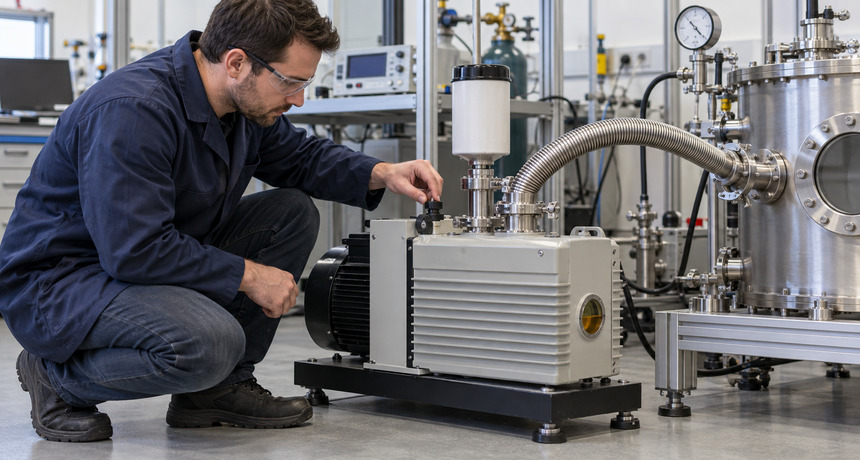
How Gas Ballast Changes Pump-Down and Vapor Handling
Gas ballast is one of the most useful and misunderstood controls on an oil-sealed vacuum pump. Opening it admits a controlled flow of gas into the pump during compression. That sounds counterproductive when the goal is to remove gas, but the added flow helps condensable vapor leave the pump before it becomes liquid. Used correctly, gas ballast protects oil quality, shortens recovery after wet processes, and makes repeated pump-down cycles more predictable.
The tradeoff is equally important: an open ballast usually raises the pump’s attainable pressure and increases exhaust flow. It is an operating tool, not a setting that should be left in one position without considering the process. Understanding when to open it, when to close it, and what the resulting pressure change means is especially important for oil-sealed rotary vane pumps handling water vapor, solvents, or other condensable loads.
How gas ballast prevents condensation
A rotary vane pump draws gas into an expanding chamber, isolates it, and then reduces the chamber volume until the exhaust valve opens. If the trapped gas contains vapor, compression raises the vapor’s partial pressure. Once that partial pressure reaches the saturation pressure at the pump’s temperature, the vapor can condense. Water is the most familiar example, but the same principle applies to many process liquids.
Gas ballast introduces a measured amount of non-condensable gas late enough in the cycle that it does not simply flow back toward the inlet. The added gas helps the compression chamber reach exhaust pressure sooner, before the condensable component reaches the conditions that would turn it into liquid. The vapor is then discharged with the ballast flow instead of remaining in the pump and mixing with the oil.
This is why pumps intended for vapor service often provide one or more ballast positions. The NAVAC NRS single-stage rotary vane pump and the NAVAC NRD dual-stage series are examples of product families that provide adjustable gas-ballast operation. The available settings, water-vapor tolerance, and permitted ballast gas are model-specific, so the operating manual remains the authority for any particular pump.
What changes when the ballast opens
Opening the ballast increases the quantity of gas the pump must move. The pump therefore settles at a higher ultimate pressure than it can reach with the ballast closed. That higher pressure does not mean the pump has failed. It is the expected cost of improving vapor tolerance. Once the vapor load has passed and the pump has been cleaned out, closing the ballast allows it to return toward its normal blanked-off pressure.
The extra flow also changes what happens at the exhaust. An oil-sealed pump may produce more visible mist or carry more oil toward the outlet while ballasted. Proper vacuum pump filters and a correctly sized oil mist eliminator can control exhaust aerosol, but they must not create excessive backpressure. If the pump uses an oil-return arrangement, follow the manufacturer’s instructions rather than assuming every exhaust accessory can return oil safely under every operating condition.
When gas ballast helps
Gas ballast is most useful when the incoming load contains enough condensable vapor to contaminate the pump. Vacuum ovens, rotary evaporation, freeze-drying support equipment, chamber drying, refrigeration service, and processes that expose a cool pump to humid air are common examples. It can also help a pump recover after a wet cycle by carrying residual vapor out of the mechanism.
It does not increase the pump’s basic pumping speed or make an undersized pump suitable for unlimited vapor throughput. Every design has a specified vapor-handling capacity. If the vapor load exceeds that capacity, liquid can still accumulate even with the ballast open. A cold pump is also more likely to condense vapor, which is why warm-up matters before the process begins.
A practical operating sequence
- Start with the correct oil level and oil type. Cloudy, separated, discolored, or unusually thin oil is a warning that the existing charge may already be contaminated. Replacement oil must match the pump specification; the selection of vacuum pump oil is part of the operating procedure, not an interchangeable consumable decision.
- Warm the pump with its inlet isolated according to the manufacturer’s instructions. Opening the ballast during warm-up can help the pump reach a stable operating temperature and clear moisture left from storage or a previous run.
- Open the appropriate ballast setting before or while the condensable load enters the pump. Watch inlet pressure and process behavior because the open ballast reduces the best pressure the pump can achieve.
- Keep the ballast open while significant vapor is passing through the pump. Closing it simply because pressure has stopped falling can force vapor to condense in the mechanism and prolong the total recovery.
- After the process ends, isolate the inlet and continue running the warm pump with ballast open long enough to purge residual vapor. Then close the ballast and confirm that the pump returns toward its normal pressure. The required cleanup time depends on pump size, temperature, vapor quantity, and oil condition.
Limits and safety considerations
Atmospheric air is a common ballast gas, but it is not suitable for every process. Flammable, explosive, toxic, or oxygen-sensitive vapors may require an inert ballast gas such as nitrogen and a system designed for that service. The pump manual, facility safety requirements, and process hazard review must determine the allowable gas and flow. Gas ballast does not make an incompatible or hazardous process safe by itself.
Ballast also does not solve upstream contamination. Oil vapor moving toward the chamber is a different flow path from oil mist leaving the exhaust. If chamber cleanliness is critical, review pump choice, traps, valves, and the broader causes described in The Role of Backstreaming in Vacuum Contamination. The comparison between oil-sealed and oil-free vacuum pumps is also useful when vapor tolerance, hydrocarbon risk, and maintenance effort must be weighed together.
What poor recovery reveals
A pump that will not recover after a vapor cycle deserves investigation. Confirm that the pump is warm, the inlet is truly isolated, the ballast passage is open, and the exhaust is not restricted. Inspect the oil through the sight glass. Persistent cloudiness often indicates water or another incompatible liquid in the oil; a single cleanup cycle may not restore it. Follow the manual’s oil-change procedure and dispose of contaminated fluid correctly.
Mechanical wear, blocked passages, damaged valves, degraded seals, or a broken gas ballast control assembly can produce similar symptoms. If fresh oil and the approved cleanup procedure do not restore performance, continuing to run the pump can spread contamination or increase internal damage. A pump rebuild service can evaluate the mechanism, replace worn parts, and verify performance under controlled test conditions.
Conclusion
Gas ballast improves vapor handling by keeping condensable material in the gas phase long enough to leave the pump. The same added gas raises attainable pressure and increases exhaust flow, so the setting should follow the process rather than remain permanently open or closed. A warm pump, correct ballast timing, clean oil, adequate cleanup, and safe ballast gas provide the best chance of consistent pump-down without trapped moisture or solvent.
If your pump struggles after wet cycles, produces contaminated oil, or needs a better vapor-handling setup, contact the High Vac Depot team for help selecting the right pump, oil, exhaust filtration, and maintenance approach for your application.






Leave a Reply
You must be logged in to post a comment.