


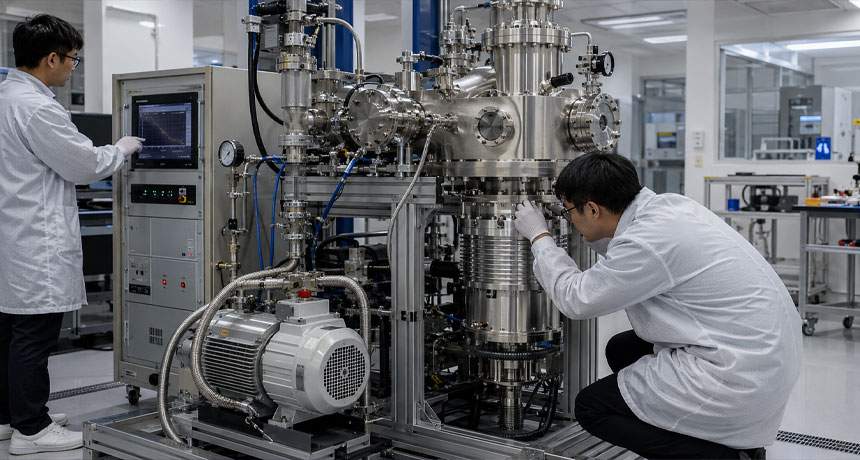
The Impact of Magnetic Levitation on Turbo Pump Performance
Turbomolecular pumps are built around speed, precision, and careful mechanical control. A rotor spinning at tens of thousands of revolutions per minute has to move gas molecules efficiently while staying stable, balanced, and protected from contact damage. In that environment, bearing design is not a minor detail. It directly affects vibration, service life, cleanliness, reliability, and how well the pump performs in demanding high-vacuum applications.
Magnetic levitation, often shortened to maglev, changes the way a turbo pump supports and controls its rotor. Instead of relying entirely on mechanical contact bearings, a magnetically levitated turbo pump uses electromagnetic fields to suspend and control the rotor during operation. In many designs, sensors monitor rotor position and control electronics adjust magnetic forces in real time. The result is a rotor that can run with very little physical contact, reducing friction and wear.
For vacuum users, the practical question is not whether maglev technology is impressive. It is whether it improves the system in ways that matter for the application. In many high-value research, coating, semiconductor, analytical, and industrial systems, the answer can be yes. But the impact depends on the process, the pump size, the duty cycle, contamination sensitivity, and how the entire vacuum system is designed.
What magnetic levitation changes inside a turbo pump
A conventional turbo pump depends on bearings to support the rotor shaft. Depending on the design, those bearings may be oil-lubricated, grease-lubricated, ceramic, hybrid, or otherwise engineered for very high rotational speed. Mechanical bearing technology can be extremely reliable when used correctly, and many applications do not require a fully magnetically levitated design.
Maglev technology changes the contact equation. By using magnetic fields to suspend the rotor, it reduces or eliminates bearing contact during normal operation. That means less mechanical friction, less bearing wear, and less vibration generated by rolling or sliding contact. It also reduces the need for lubricants near the high-speed rotor assembly, which can matter in clean vacuum applications.
This does not mean a maglev pump has no mechanical protection. Most designs include backup or touchdown bearings that protect the rotor during startup, shutdown, power loss, or fault conditions. The difference is that those bearings are not intended to carry the normal operating load continuously. The rotor is controlled magnetically during operation, which is where the performance advantages appear.
High Vac Depot’s turbo pumps category includes a range of turbomolecular pump options for high-vacuum applications. Understanding bearing design helps users compare more than just pumping speed or inlet flange size.
Lower vibration and better process stability
One of the biggest performance advantages of magnetic levitation is reduced vibration. Turbo pumps already require careful rotor balancing, but any high-speed rotating machine can transmit mechanical energy into the chamber, frame, or instrument. In some systems, that vibration is only a nuisance. In others, it affects measurement quality, imaging stability, film uniformity, or sensitive alignment.
Applications such as electron microscopy, surface analysis, optical coating, semiconductor processing, mass spectrometry, and quantum-device research can be sensitive to vibration. A maglev turbo pump can help reduce vibration at the source because the rotor is not continuously riding on conventional contact bearings during normal operation. Lower vibration can contribute to quieter operation, more stable instruments, and reduced mechanical coupling into sensitive fixtures.
That benefit is not automatic, however. Pump mounting, frame stiffness, flexible connections, foreline routing, and chamber supports all affect the final vibration environment. A low-vibration pump installed poorly can still transmit unwanted motion. When vibration is a key requirement, the pump should be considered part of the entire mechanical system, not just a standalone component.
Less wear and longer service intervals
Because magnetic levitation reduces normal operating contact, it can significantly reduce bearing wear compared with designs that depend more heavily on mechanical bearings. This can translate into longer service intervals, especially in applications with long duty cycles or continuous operation.
That matters because turbo pump service is not just about parts cost. It also affects production uptime, instrument availability, and scheduling. A research lab may lose valuable experiment time. A coating shop may lose production capacity. A process tool may need to be taken offline. In those environments, the value of longer maintenance intervals can exceed the difference in purchase price.
High Vac Depot’s pump rebuild service is still important because every vacuum pump has operating limits, contamination exposure, and wear considerations. Maglev technology can reduce some common bearing-related issues, but it does not eliminate the need for proper installation, clean operation, correct venting, cooling, and periodic evaluation.
Cleaner operation for contamination-sensitive systems
Cleanliness is another major reason users consider magnetically levitated turbo pumps. In high-vacuum work, contamination can come from many places: process byproducts, outgassing materials, pump oil vapor, foreline contamination, poor venting practice, or dirty hardware. Bearing lubrication is one more factor to consider, especially in sensitive applications.
By reducing reliance on lubricated mechanical contact in the high-speed rotor support system, maglev designs can help lower contamination risk inside the pump. This is especially relevant in processes where hydrocarbons, particles, or lubricant migration could affect surfaces, films, analytical data, or device performance.
Clean pumping architecture does not stop with the turbo pump. The backing pump matters too. Many sensitive systems pair turbo pumps with oil-free backing pumps such as dry scroll pumps to reduce hydrocarbon risk from the foreline. High Vac Depot’s article on the role of backstreaming in vacuum contamination is a useful companion when thinking through pump-related contamination pathways.
Performance under demanding operating conditions
Magnetically levitated turbo pumps are often chosen for demanding operating conditions because active control can help maintain rotor stability. In some designs, the control system can compensate for imbalance or changing load conditions. That can be useful when the pump is exposed to variable gas loads, repeated cycling, harsh venting, or industrial process environments.
Still, maglev should not be treated as permission to ignore operating limits. Turbo pumps can be damaged by sudden air inrush, excessive foreline pressure, particles, condensation, improper venting, or exposure to incompatible process materials. Magnetic bearings improve rotor support, but they do not change the basic physics of turbomolecular pumping.
System design remains critical. Proper isolation valves, vent valves, backing pumps, pressure monitoring, and interlocks help protect the pump. High Vac Depot’s vacuum valves and vacuum gauges categories are relevant because pump protection depends on knowing what the system is doing and controlling how gas moves through it.
Pump speed, compression, and the real meaning of “performance”
It is important to be precise about what magnetic levitation does and does not change. Maglev bearings do not magically increase pumping speed by themselves. Pumping speed, compression ratio, gas throughput, and ultimate pressure depend heavily on rotor geometry, blade design, drag stages, inlet size, backing conditions, gas species, and conductance between the pump and chamber.
Where maglev can improve performance is in the way the pump maintains stable operation over time. Lower friction, lower vibration, cleaner bearing support, and reduced wear can help preserve the conditions under which the pump performs well. That is a different kind of performance than a larger inlet or faster rotor design, but it may be just as important in a real facility.
For example, a coating system may care about uptime and low contamination. A metrology instrument may care about vibration. A research chamber may care about stable pressure over long experiments. A semiconductor process tool may care about reliability under frequent cycling. In each case, the right bearing design supports the larger performance goal.
High Vac Depot’s article on vacuum level and pumping speed is a helpful reminder that system performance depends on delivered pumping speed at the chamber, not simply the pump specification printed on a datasheet.
Installation and system integration still matter
A magnetically levitated turbo pump is a sophisticated component, but it still has to be installed correctly. The pump needs suitable backing pressure, proper cooling, correct controller setup, adequate electrical supply, clean connections, and mechanical support. The inlet connection, foreline, valves, and chamber geometry all affect final performance.
Hardware selection matters. High-vacuum systems commonly rely on metal-sealed connections where leak integrity and bakeability are important. CF flanges and fittings are common in demanding high-vacuum and UHV environments, while ISO flanges and fittings are often used where larger pump connections or higher conductance paths are needed.
Control integration also matters. Many turbo pumps rely on dedicated controllers, communication cables, and accessories for monitoring speed, temperature, current, fault status, and interlocks. High Vac Depot’s turbo controllers and turbo packages can be useful starting points when matching pumps with the support hardware needed for reliable operation.
For complete system setups, turbo pump stations may be appropriate when users need an integrated pumping solution rather than piecing together components one at a time.
When maglev is worth considering
Magnetic levitation is most attractive when the application benefits from one or more of the following:
- Low vibration near sensitive instruments or process chambers
- Reduced bearing wear and longer service intervals
- Cleaner operation with reduced lubricant-related risk
- Continuous operation or high uptime requirements
- Harsh or demanding process environments
- High-value tools where pump failure is costly
- Applications where stability matters as much as base pressure
That does not mean every turbo pump application needs maglev. For general laboratory use, intermittent operation, less sensitive chambers, or budget-limited systems, a well-selected mechanical or hybrid-bearing turbo pump may be the more practical choice. The best pump is the one that matches the application, not simply the one with the most advanced bearing system.
If symptoms such as vibration, unstable pump behavior, slow pump-down, controller faults, or poor base pressure are already present, High Vac Depot’s article on diagnosing pressure instabilities in a vacuum system and guide to troubleshooting common vacuum issues can help narrow the problem before replacing major equipment.
Conclusion
Magnetic levitation can have a meaningful impact on turbo pump performance, but its value is best understood in practical terms. It can reduce vibration, lower mechanical wear, support cleaner operation, extend service intervals, and improve stability in demanding high-vacuum environments. Those advantages are especially valuable in contamination-sensitive, vibration-sensitive, high-duty-cycle, or high-cost-of-downtime applications.
At the same time, maglev technology does not replace good vacuum engineering. Pumping speed, conductance, backing pressure, cooling, controller setup, hardware selection, gauge strategy, and operating practice still determine how well the system performs. The right turbo pump must be matched to the chamber, process, and real-world operating conditions.
If you need help comparing turbo pump options, deciding whether magnetic levitation is worth the investment, troubleshooting pump performance, or designing a high-vacuum system, contact the experts at High Vac Depot. The team can help you evaluate pumps, controllers, backing pumps, gauges, valves, fittings, and system-level requirements so your vacuum equipment supports the performance your application needs.








Leave a Reply
You must be logged in to post a comment.