


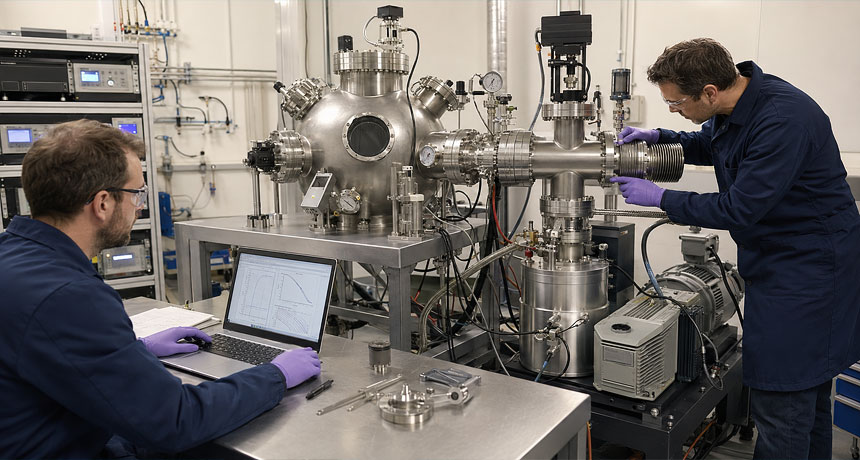
Properly Sizing a Vacuum System for Your Application
Properly sizing a vacuum system involves more than selecting a pump with enough pumping speed. The pump, chamber, plumbing, valves, gauges, gas load, process conditions, and required cycle time all work together. A pump that looks perfect on a datasheet may perform very differently once it is connected to a real chamber through several feet of tubing, elbows, valves, and fittings.
Undersizing creates obvious problems: long pump-down times, poor ultimate pressure, excessive pump loading, and difficulty maintaining process conditions. Oversizing can be just as wasteful. A larger pump may add cost, heat, noise, power consumption, and maintenance without significantly improving chamber performance if the system is limited by conductance or gas load.
The goal is not to install the biggest pump available. It is to provide the right effective pumping speed where it matters. High Vac Depot’s article on vacuum level and pumping speed is a useful starting point for understanding that distinction.
Start with the required operating pressure
The first sizing question should be simple: what pressure does the process actually require?
A system intended to operate at 10 Torr has very different needs from one that must routinely reach 10⁻⁶ Torr. Rough vacuum can often be produced with a single positive-displacement pump. High vacuum may require a roughing pump followed by a turbomolecular or other high-vacuum pumping stage. Ultra-high vacuum adds even more attention to outgassing, materials, seals, bakeout, and gas species.
It is also important to distinguish between ultimate pressure and operating pressure. Ultimate pressure is the lowest pressure a pump may achieve under favorable test conditions. Operating pressure is where the actual process runs while gas loads, chamber surfaces, process gases, leaks, and other real-world factors are present.
Sizing a system around a pump’s ultimate-pressure specification alone is therefore a mistake. The pump must provide useful pumping speed at the pressure where the application operates.
High Vac Depot’s broad selection of vacuum pumps includes technologies intended for very different pressure ranges. Choosing the pumping principle should come before choosing the specific pump size.
Determine chamber volume and required pump-down time
Chamber volume strongly affects evacuation time. Removing gas from a 10-liter chamber is very different from evacuating a 1,000-liter vessel, even when both systems need the same final pressure.
For a simplified ideal system with constant effective pumping speed and negligible gas load, pump-down time can be approximated by:
t = (V / S) × ln(P₁ / P₂)
where:
- t is pump-down time
- V is chamber volume
- S is effective pumping speed
- P₁ is starting pressure
- P₂ is final pressure
This equation is useful for preliminary thinking, but real vacuum systems rarely behave this simply. Pumping speed changes with pressure, gas flow transitions between viscous and molecular regimes, conductance limits become important, and outgassing begins to dominate at lower pressures.
Still, chamber volume and desired cycle time establish an important starting point. If one production chamber must evacuate in three minutes while another research chamber can take an hour, their pumping systems may look very different even if the target pressure is similar.
High Vac Depot’s free vacuum calculators can help with preliminary calculations involving gas load, throughput, rate of rise, conductance, and other system parameters.
Calculate the gas load, not just the chamber volume
Once a vacuum system reaches lower pressure, the amount of gas continuously entering the chamber often matters more than the original volume of air.
Gas load can come from:
- Outgassing from chamber walls and internal components
- Real leaks
- Permeation through elastomer seals
- Process gases
- Water vapor
- Solvents or condensable vapors
- Product degassing
- Backstreaming
- Virtual leaks and trapped volumes
The fundamental steady-state relationship is:
Q = S × P
where Q is gas load or throughput, S is effective pumping speed, and P is pressure.
Rearranged, the required pumping speed becomes:
S = Q / P
This relationship is central to vacuum-system sizing. If a process continuously introduces a known gas load and must hold a certain pressure, the pump has to remove that gas at least as quickly as it enters.
This is one reason sizing based only on chamber volume can be misleading. Two identical chambers can require very different pumps if one contains clean stainless-steel hardware while the other continuously receives process gas or contains materials with significant outgassing.
Account for conductance before increasing pump size
One of the most common sizing mistakes is assuming that the pumping speed listed on the pump will also be available at the chamber.
It usually will not.
Tubing, valves, elbows, traps, reducers, hoses, and other restrictions have finite conductance. The relationship between pump speed and conductance can be expressed as:
1 / Sₑ = 1 / Sₚ + 1 / C
where:
- Sₑ is effective pumping speed at the chamber
- Sₚ is pump speed
- C is conductance between the chamber and pump
Suppose a pump is rated at 500 L/s but the plumbing between the pump and chamber has a conductance of only 100 L/s. Installing a 1,000 L/s pump will not give the chamber 1,000 L/s of pumping speed. The restriction remains.
This becomes particularly important in molecular flow, where tube diameter has a major influence on conductance. Short, large-diameter connections are generally far more effective than long, narrow lines.
Before buying a larger pump, it may be better to increase line diameter, shorten the pumping path, remove unnecessary elbows, or use a less restrictive valve. High Vac Depot’s article Can a Vacuum Pump Be Too Powerful for an Application? explores exactly why more nameplate pumping speed does not always translate into better system performance.
Choose the appropriate roughing pump
Most vacuum systems begin evacuation with a roughing pump. Even systems intended for high or ultra-high vacuum generally need a mechanical pump to bring the chamber down from atmosphere and, in many cases, to back another pumping stage.
Common options include oil-sealed rotary vane, dry scroll, diaphragm, dry screw, and multi-stage roots or lobe technologies.
Rotary vane pumps can provide strong roughing performance and relatively low ultimate pressure in a compact package. Oil-free dry scroll pumps are often preferred in contamination-sensitive laboratories, analytical instruments, and clean processes.
The choice depends on more than speed. Consider vapor handling, particulate tolerance, chemical compatibility, noise, oil contamination risk, maintenance requirements, and continuous operating pressure.
High Vac Depot’s guide to choosing the right roughing pump and comparison of oil-sealed and oil-free vacuum pumps can help narrow the technology before selecting a specific size.
Size the high-vacuum stage as part of a pumping system
Applications requiring high vacuum commonly add a turbomolecular pump after the roughing stage.
Sizing the turbo pump requires looking at inlet pumping speed, gas species, compression ratio, maximum throughput, allowable foreline pressure, backing-pump requirements, chamber conductance, and target base pressure.
A large turbo pump paired with an inadequate backing pump can perform poorly. Likewise, a properly sized turbo connected through an undersized valve or long narrow line can be conductance-limited.
The crossover between roughing and high-vacuum pumping also needs to be controlled correctly. Pressure instrumentation and interlocks should prevent the high-vacuum stage from operating outside its allowable inlet or foreline conditions.
Sizing therefore works from both ends: the high-vacuum pump must satisfy chamber requirements, and the roughing pump must satisfy the requirements of the high-vacuum pump.
Size valves and plumbing with the pump
Valves and fittings are often selected after the pump, but they should be part of the sizing calculation from the beginning.
A gate valve that is significantly smaller than the turbo inlet can become the dominant conductance restriction. Long flexible hoses can reduce effective speed. Several elbows placed in series can turn an otherwise strong pumping system into a slow one.
The available vacuum valves should be selected according to pressure range, flow requirement, isolation needs, actuation method, and conductance. The plumbing should generally remain as large and direct as practical between the chamber and high-vacuum pump.
At the same time, not every line needs maximum conductance. Roughing lines, process-gas lines, vent connections, and controlled-pressure applications may intentionally use different sizes or throttling strategies. System sizing is about controlling gas flow appropriately, not simply making every passage as large as possible.
Select gauges for the complete pressure range
A properly sized pump system also needs instrumentation capable of telling the operator what is actually happening.
No single gauge technology is ideal from atmosphere through ultra-high vacuum. Roughing systems may use Pirani, convection, capacitance, or similar sensors. High-vacuum systems may add cold cathode or hot cathode ionization gauges.
The vacuum gauges selected for the system should cover pump-down, crossover, operating pressure, and any safety or process-control setpoints.
Gauge placement also matters. A sensor located directly beside the pump may report a pressure significantly different from the pressure inside a large or conductance-limited chamber. Place measurement points where they represent the pressure that matters to the process.
Avoid both undersizing and oversizing
An undersized system often reveals itself quickly. Symptoms include excessive pump-down time, inability to maintain operating pressure, high foreline pressure, continuous operation near pump limits, or poor process stability.
Oversizing is less obvious because the system may still work. The problem is that the additional capacity may provide little benefit.
An oversized system can lead to:
- Higher equipment cost
- Increased electrical consumption
- More heat and cooling demand
- Larger plumbing and valves
- Higher maintenance expense
- Additional vibration or noise
- More aggressive pump-down than the process requires
- Difficult pressure control
- Little improvement when conductance is already limiting performance
The best system usually includes reasonable margin without relying on excessive pump capacity to compensate for poor plumbing, unnecessary gas load, or weak system design.
Validate the design with real operating data
Calculations are essential, but the final sizing decision should also consider pump curves and real process behavior.
Review pumping-speed curves rather than relying only on a maximum specification. Confirm the pump’s performance at the intended operating pressure. Check maximum allowable gas throughput and foreline pressure. Consider expected degradation as seals, tip seals, oil, filters, or other components age.
Once the system is operating, record pump-down curves. A repeatable pressure-versus-time curve becomes one of the most useful diagnostic tools available. Changes in that curve can reveal leaks, contamination, pump degradation, added gas load, or restrictions long before the system completely fails.
For more complex applications, High Vac Depot’s vacuum engineering consulting can assist with evacuation calculations, ultimate-pressure estimates, gas loads, system optimization, component selection, and complete system design.
Conclusion
Properly sizing a vacuum system means matching the entire vacuum architecture to the application. Start with the required operating pressure, chamber volume, allowable pump-down time, and expected gas load. Then calculate the effective pumping speed needed at the chamber while accounting for conductance, plumbing geometry, pump curves, process conditions, backing requirements, gauges, and valves.
The biggest pump is not automatically the best pump. A well-sized system delivers enough capacity to reach and maintain the required pressure with reasonable margin, while avoiding unnecessary cost, energy use, maintenance, and control problems.
If you are designing a new vacuum system, upgrading an existing installation, or trying to determine why a system is not meeting its pressure or pump-down goals, contact the experts at High Vac Depot. The team can help you evaluate pumps, gauges, valves, plumbing, gas loads, conductance, and application requirements to build a vacuum system that is properly sized for the work it actually needs to do.





Leave a Reply
You must be logged in to post a comment.