


The Most Common Sources of Vacuum Leaks
Vacuum leaks are one of the most common and frustrating problems in vacuum-system work. A system may have the right pump, clean hardware, and a sensible layout, but a small leak can still keep it from reaching base pressure, slow the pump-down curve, or create unstable readings during operation. In some cases, the leak is obvious. In others, the system behaves poorly even though every connection looks fine from the outside.
The challenge is that not every “leak” is the same. A real leak allows gas to enter from atmosphere or from another volume. A virtual leak is trapped gas slowly escaping from inside the system. Outgassing can also mimic leakage by adding gas load from surfaces, elastomers, lubricants, or process residue. Good troubleshooting begins by understanding where leaks most often occur and how those leak sources behave.
High Vac Depot’s article on how to design a leak-free vacuum system covers the design side of this issue, but technicians and engineers also need a practical field checklist. The most common leak sources are usually not mysterious. They tend to appear at seals, fittings, valves, welds, hoses, ports, feedthroughs, and maintenance points.
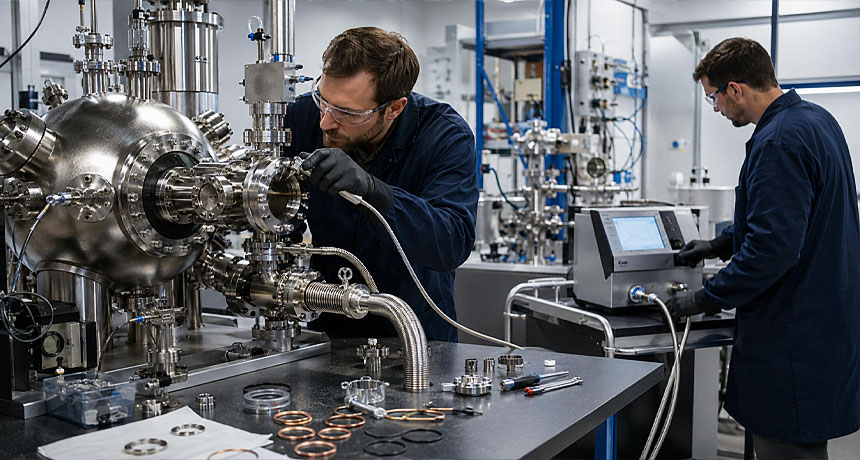
Flanges, gaskets, and O-rings
The first place to look is often the most obvious: the joints. Every flange connection is a possible leak path if the sealing surface is damaged, dirty, misaligned, under-tightened, over-tightened, or assembled with the wrong gasket or O-ring.
KF fittings are widely used because they are fast, convenient, and serviceable. They are ideal for many rough and high-vacuum connections, especially where equipment needs to be reconfigured or removed for maintenance. But KF flanges and fittings depend on proper centering-ring placement, clamp alignment, and O-ring condition. A twisted O-ring, scratched sealing surface, or clamp that is not seated evenly can create a leak that looks small but has a large effect on pump-down behavior.
CF fittings are different. They rely on metal gaskets and knife-edge sealing surfaces, which makes them a common choice for high-vacuum and ultra-high-vacuum applications. CF flanges and fittings can provide excellent leak integrity, but they are not immune to problems. A reused copper gasket, damaged knife edge, uneven bolt pattern, contaminated surface, or improper torque sequence can compromise the seal.
The best prevention is careful assembly. Inspect sealing faces before installation. Use the right gasket. Tighten evenly. Avoid dragging fittings across benches where they can pick up scratches or debris. Most flange leaks are not caused by exotic physics. They are caused by small assembly details that were easy to miss.
Valves and valve seats
Vacuum valves are another common leak source because they include moving parts, seals, shafts, seats, and interfaces between atmosphere and vacuum. A valve may leak externally through a body seal or internally across the seat. Both problems can affect performance, but they show up differently.
An external valve leak brings gas into the vacuum system from outside. An internal valve leak may allow gas to pass from one section of the system to another even when the valve appears closed. This is especially important in systems with roughing lines, process gas lines, vent lines, isolation stages, or multiple chambers.
Over time, valve seats can wear, collect residue, or become contaminated by particles. Elastomer seals can harden or deform. Bellows-sealed valves can be more robust in demanding applications, but they still require correct installation and maintenance. When working through leak problems, do not assume a valve is good simply because the handle or actuator moves correctly. The sealing surface is what matters.
If a system depends on reliable isolation, reviewing the available vacuum valves and selecting the right style for the pressure range, cleanliness requirement, and cycling frequency can prevent a lot of future troubleshooting.
Hoses, bellows, and flexible connections
Flexible connections are useful because they reduce stress, simplify alignment, and make pump installation easier. They can also become leak sources if they are bent too sharply, mechanically strained, contaminated, cracked, or connected with poor end fittings.
Metal bellows are often used where flexibility is needed without sacrificing vacuum integrity. Flexible hoses may be used in forelines, pump connections, or service points. In either case, the connection should not carry unnecessary mechanical load. A pump that is hanging from the line, a hose that is twisted into position, or a bellows under side-load can create sealing problems at the ends even if the hose itself is intact.
High Vac Depot’s broader hardware and fittings category is useful when matching connection types, adapters, elbows, reducers, and flexible hardware. Good leak prevention often comes down to reducing mechanical stress before it reaches the seal.
Threaded fittings, adapters, and mixed hardware
Threaded connections can be convenient, but they are not automatically vacuum-tight. Pipe threads, compression fittings, adapters, and mixed hardware transitions all require special attention because they can create small spiral leak paths or depend heavily on correct installation technique.
Adapters are especially worth checking because they are often added later in the life of a system. A chamber may begin with a clean, simple layout, then slowly accumulate ports, reducers, tees, gauge fittings, temporary lines, and diagnostic connections. Every added transition increases the number of possible leak paths.
The risk is not only the fitting itself. It is also the way the fitting changes the system layout. Unsupported hardware can create leverage on a flange. Heavy gauge assemblies can sag. A reducer can place stress on a small port. A temporary fitting can become permanent without ever being treated like a critical seal.
When adapters are necessary, use parts that are appropriate for the vacuum range and installation environment. Avoid forcing mismatched hardware to work. If the system is becoming crowded or awkward, it may be time to rethink the layout instead of adding one more fitting.
Welds, brazed joints, and chamber fabrication
Welded and brazed joints can be very reliable, but poor fabrication can create leak paths that are difficult to diagnose. Pinholes, incomplete penetration, porous welds, cracks near heat-affected zones, and poorly finished ports can all cause real leaks. These leaks may be small enough to escape visual inspection but large enough to keep the system from performing properly.
Fabrication-related leaks are especially frustrating because they may not appear until the chamber is under vacuum, thermally cycled, baked, or placed under mechanical stress. A weld that seems fine during assembly may reveal a problem after repeated operation. This is one reason vacuum chambers and custom components should be designed with inspection, cleaning, and leak checking in mind from the beginning.
High Vac Depot’s custom fabrication resources are relevant for systems where standard chambers or fittings do not fit the application. Good fabrication is not just about shape and fit. It is about vacuum integrity, clean internal geometry, appropriate materials, and practical testing access.
Feedthroughs, gauges, and instrument ports
Instrumentation ports are another frequent source of leaks because they combine mechanical sealing with electrical, thermal, or measurement requirements. A pressure gauge may be correctly selected but poorly mounted. A feedthrough may be functional electrically but compromised mechanically. A port plug may have been removed and reinstalled several times without careful seal inspection.
When troubleshooting, pay attention to every gauge, sensor, viewport, thermocouple feedthrough, electrical feedthrough, and blanked-off port. These points are sometimes treated as secondary hardware, but they are still vacuum boundaries. If a sensor was recently changed, a cable was pulled, or a gauge was rotated to improve visibility, the seal may have been disturbed.
High Vac Depot’s vacuum gauges category and article on best practices for installing and using vacuum pressure transducers are good references for thinking about instrumentation as part of the vacuum system rather than as an add-on.
Pump connections and foreline leaks
Leaks near the pump can be misleading because they may not look like chamber leaks at first. A roughing pump connection, foreline hose, exhaust-side issue, or backing-line fitting can affect pump-down performance and make the entire system appear weak.
Foreline leaks are especially important in systems that use turbo pumps, diffusion pumps, or other high-vacuum pumps backed by a roughing pump. If the backing side is not tight, the high-vacuum stage may struggle or operate under poor conditions. A small leak in a foreline can also introduce air and moisture into places where they do not belong, increasing pump load and slowing recovery.
When diagnosing poor base pressure, do not focus only on the chamber. Check the pump inlet, foreline clamps, hose fittings, valve connections, and any service ports between the chamber and pump. If the roughing side is unstable, the rest of the system may never behave correctly.
Virtual leaks and trapped volumes
A virtual leak is not a hole to atmosphere. It is a trapped gas source inside the vacuum system that releases gas slowly over time. Common causes include blind tapped holes, unvented fasteners, overlapping surfaces, trapped volumes behind fittings, porous materials, contaminated threads, and poorly designed internal geometry.
Virtual leaks can be difficult because they often mimic real leaks. The system may pump down slowly, stabilize poorly, or show a persistent pressure rise after isolation. But a helium leak test may not show an external leak because the gas source is internal. High Vac Depot’s article on virtual leaks and why they matter explains the basic issue, while the more recent guide to minimizing virtual leaks in complex vacuum systems looks at prevention in greater detail.
The best way to prevent virtual leaks is to design them out. Use vented screws where appropriate. Avoid blind cavities. Keep internal assemblies simple. Make sure trapped volumes have a path to pump out. Once a virtual leak is built into a chamber, it can be much harder to correct.
Maintenance damage and human handling
Some leak sources are created during maintenance. A flange face gets scratched. A gasket is reused. A clamp is dropped. A port is capped quickly without cleaning. A valve is forced open or closed. A hose is bent too sharply to make it fit. None of these mistakes are unusual, and most are preventable.
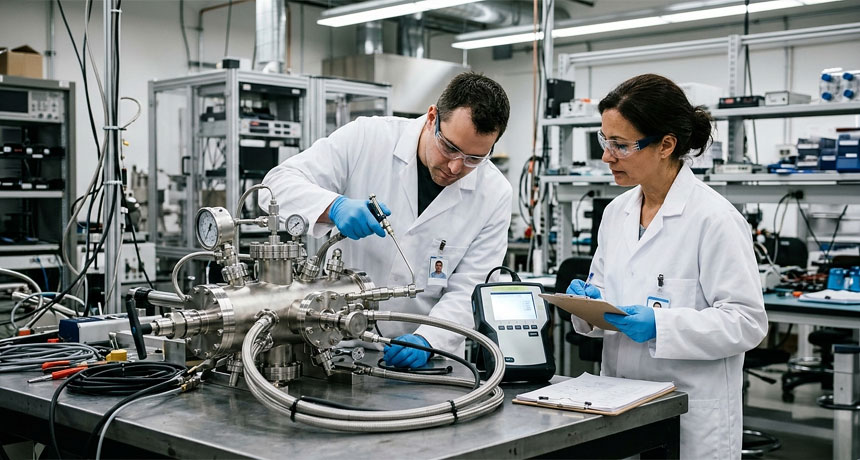
A good maintenance process should include inspection, cleaning, correct replacement parts, and a leak-check plan after reassembly. High Vac Depot’s article on considerations when leak checking your vacuum system is a practical starting point, and helium leak detectors are often the most efficient tool for finding small leaks in high-vacuum systems. For short-term testing needs, helium leak detector rental can be a practical option when buying equipment is not necessary.
For lower vacuum systems, simpler methods may sometimes be appropriate. High Vac Depot’s guide to bubble leak testing for low vacuum systems explains where that approach can fit. The key is choosing a leak-check method that matches the vacuum level, system size, and consequence of failure.
Conclusion
The most common vacuum leaks usually come from familiar places: flanges, O-rings, valves, hoses, adapters, welds, feedthroughs, pump connections, and trapped internal volumes. The difficulty is not always knowing that these areas can leak. The difficulty is inspecting them carefully, understanding how each leak source behaves, and choosing the right diagnostic method before replacing parts unnecessarily.
If your system is struggling with poor base pressure, slow pump-down, pressure instability, or recurring leak problems, contact the experts at High Vac Depot. The team can help with leak detection equipment, vacuum hardware, gauges, fittings, valves, fabrication guidance, and practical troubleshooting support so you can find the source of the problem and get the system back under control.









Leave a Reply
You must be logged in to post a comment.