


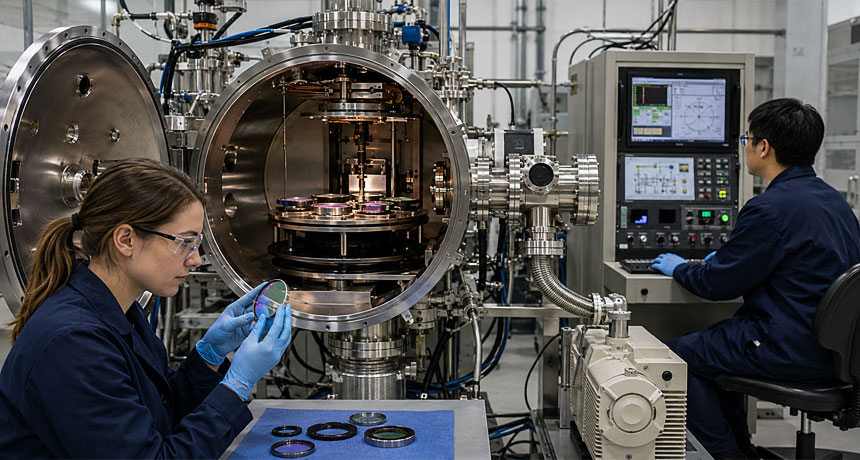
The Science of Optical Coatings in Vacuum Deposition
Optical coatings look simple from the outside. A lens, mirror, filter, or window may appear to have only a faint tint or reflective surface. But the performance of that surface often depends on a carefully engineered stack of thin films, each deposited with controlled thickness, composition, density, and optical behavior. In demanding applications, the coating is not decoration. It determines how the optic reflects, transmits, absorbs, filters, or protects light.
Vacuum deposition is central to this work because optical coatings require cleaner, more controlled conditions than ambient processing can provide. When a coating layer may be only a fraction of a wavelength thick, small changes in material purity, deposition rate, pressure, gas composition, or substrate cleanliness can affect the final optical result. That is why optical coating systems depend on reliable vacuum pumps, stable pressure measurement, low-contamination hardware, and careful process control.
High Vac Depot’s article on vacuum solutions for thin film deposition gives a useful overview of the broader deposition environment. Optical coatings are one of the clearest examples of why that environment matters.
What optical coatings are designed to control
Optical coatings are thin-film layers applied to a substrate to change the way light behaves at the surface. Depending on the application, a coating may be designed to reduce reflection, increase reflection, split a beam, block certain wavelengths, transmit others, protect a surface, or create a specific spectral response.
The key principle is interference. When light reflects from the top and bottom boundaries of a thin film, those reflected waves can either reinforce or cancel each other depending on the optical thickness of the layer. Optical thickness depends on both the physical thickness of the film and the refractive index of the material. By stacking materials with different refractive indices, coating designers can shape reflection and transmission over a chosen wavelength range.
This is why optical coating work is so sensitive. If the layer is too thick, too thin, too porous, contaminated, or compositionally inconsistent, the coating may shift away from its design wavelength. A coating intended for a laser optic, infrared window, imaging lens, or bandpass filter may still look acceptable visually while failing in actual optical performance.
Why vacuum deposition is used
Vacuum deposition provides three major advantages for optical coatings: cleanliness, directionality, and process control.
Cleanliness matters because coatings can be affected by water vapor, hydrocarbons, particles, oxygen content, and other residual gases. The lower and cleaner the vacuum environment, the less likely unwanted gas molecules are to become trapped in the growing film. This is especially important for coatings that must maintain low absorption, high transmission, high reflectivity, or strong laser-damage performance.
Directionality matters because many coating processes depend on controlled movement of atoms or molecules from a source to the substrate. In high vacuum, the mean free path is longer, so deposited material can travel with fewer gas-phase collisions. That helps improve repeatability and makes it easier to control coating geometry.
Process control matters because optical coatings are built layer by layer. Each layer has to be deposited at the right rate, under the right pressure conditions, and with the right substrate temperature or ion assistance when needed. A vacuum system that cannot hold stable pressure will make that control harder. High Vac Depot’s article on diagnosing pressure instabilities in a vacuum system is relevant here because coating systems often reveal pressure problems through changes in film quality or repeatability.
Common vacuum deposition methods for optical coatings
Several deposition methods are used for optical coatings, and each has strengths and tradeoffs.
Thermal evaporation and electron-beam evaporation heat a material until it vaporizes and condenses on the optical substrate. These methods can provide efficient deposition and are widely used for many optical thin films. The quality of the film depends on vacuum quality, source control, substrate preparation, deposition rate, and the nature of the material being evaporated.
Sputtering removes atoms from a target material using energetic ions, often in an argon plasma. The material then deposits onto the substrate. Sputtered films are often denser and more adherent than simple evaporated films, although the system is more complex and process pressure plays a major role.
Ion-assisted deposition and ion-beam sputtering add another level of control. Ion energy can help densify the growing film, improve adhesion, reduce voids, and influence stress. These benefits can be important for precision optics, harsh environments, or coatings that need strong long-term stability.
Regardless of the method, the vacuum system is not just background equipment. It influences film structure, contamination, deposition rate, uniformity, and chamber recovery between runs.
Vacuum quality and contamination control
Optical coatings are highly sensitive to contamination because the film itself is the functional component. A small amount of water vapor, oil vapor, particulate contamination, or outgassed residue can change the film’s density, absorption, adhesion, or spectral behavior.
Outgassing is a common concern. Chamber walls, elastomers, fixtures, tooling, adhesives, lubricants, and substrate carriers can release gas under vacuum, especially during pump-down or heating. High Vac Depot’s article on outgassing and why it matters is a strong companion topic for optical coating users because outgassed materials can end up exactly where they are least wanted: in the deposited film or on the optical surface.
Backstreaming and pump contamination also matter. In sensitive coating systems, oil-free or well-isolated pump architectures are often preferred to reduce hydrocarbon risk. Dry scroll pumps are commonly used where clean roughing or backing performance is important, while turbo pumps are often used to reach and maintain high-vacuum conditions for deposition.
Leak integrity is part of contamination control as well. Air leaks can introduce oxygen, nitrogen, water vapor, and other atmospheric contaminants into the chamber. For demanding coating systems, helium leak checking may be necessary to confirm system integrity. High Vac Depot’s leak detectors can be useful for teams that need to verify chamber, valve, or feedthrough performance before blaming process drift on coating chemistry.
Pumps, gauges, and hardware behind repeatable coatings
A coating system is only as stable as the vacuum architecture behind it. Pumping speed, conductance, chamber volume, gas load, and process gas flow all affect how quickly the system reaches operating pressure and how stable it remains during deposition.
In many systems, roughing equipment brings the chamber down from atmosphere, then high-vacuum pumps take over before deposition begins. The delivered pumping speed at the chamber matters more than the pump’s nameplate number. Long lines, narrow conductance paths, restrictive valves, and poor pump placement can all reduce effective performance. High Vac Depot’s calculators can help engineers think through conductance, pump-down, and related vacuum behavior during system planning.
Pressure measurement is just as important. Optical coating processes often depend on knowing when the chamber is ready, when process gas is stable, and whether the pressure is drifting during the run. The right vacuum gauges allow operators to monitor both roughing and high-vacuum conditions. Gauge placement should be chosen carefully so readings represent the process region, not just the area near the pump.
Hardware choices also affect performance. High-vacuum coating systems often use metal-sealed connections where leak rate, bakeability, and cleanliness matter. CF flanges and fittings are common in demanding vacuum environments because they provide strong sealing performance when installed correctly. KF and ISO hardware may still be useful in appropriate sections, but the seal strategy should match the pressure range, cleanliness requirement, and maintenance needs of the system.
Film uniformity and process repeatability
Optical coatings must be uniform enough to meet the optical specification across the usable area of the component. This can be difficult when coating curved lenses, large substrates, domes, windows, or batches of smaller parts. Uniformity depends on source geometry, substrate rotation, chamber layout, deposition angle, fixturing, and process stability.
Layer thickness control is especially important. A coating designed around a quarter-wave or half-wave optical thickness will shift if the deposited layer is off target. For a simple coating, that may reduce performance. For a complex multilayer stack, small errors can accumulate across dozens of layers and move the final spectral curve away from specification.
This is why vacuum deposition systems often combine physical hardware control with optical or crystal monitoring. Operators need to control deposition rate, total thickness, source behavior, and substrate exposure. They also need stable vacuum conditions so process variables do not change unexpectedly during a run.
High Vac Depot’s article on the role of vacuum in nanotechnology manufacturing speaks to a similar principle: when performance depends on extremely small structures or films, the process environment must be controlled with unusual care.
Practical design considerations for coating systems
For teams building or improving an optical coating system, several practical questions are worth asking early:
Is the pump architecture clean enough for the coating requirement? Oil-sealed pumps may be acceptable in some environments, but highly sensitive optical coatings may justify oil-free roughing, traps, or stronger isolation.
Is the chamber geometry helping or hurting uniformity? Port locations, pump placement, source-to-substrate distance, rotation hardware, and fixturing can all influence the deposited film.
Are materials and seals chosen for vacuum compatibility? Elastomers, adhesives, plastics, and lubricants should be evaluated carefully because contamination may not appear until the system is under vacuum or heat.
Can the system be serviced without damaging cleanliness? Optical coating systems need maintenance access, but frequent opening and poor handling can introduce particles, fingerprints, moisture, and residue.
Does the system have enough diagnostic capability? Reliable gauges, leak detection access, and process monitoring can reduce the time spent guessing when a coating result changes.
For custom chambers, unusual fixtures, or specialized deposition layouts, High Vac Depot’s custom fabrication resources may be helpful. For application-specific questions about pumps, components, or system layout, High Vac Depot also offers consulting support.
Conclusion
Optical coatings depend on controlled thin-film behavior, and controlled thin-film behavior depends heavily on the vacuum environment. Vacuum deposition allows coating materials to be deposited with greater cleanliness, directionality, and process control than ordinary atmospheric methods. But the coating result still depends on the details: pump selection, pressure stability, contamination control, gauge placement, leak integrity, chamber geometry, and repeatable operating practice.
If your application involves optical coatings, thin-film deposition, coating-system troubleshooting, vacuum contamination, or component selection, contact the experts at High Vac Depot. The team can help you evaluate pumps, gauges, fittings, leak detection tools, fabrication needs, and system-level questions so your vacuum equipment supports the optical performance you need.

Leave a Reply
You must be logged in to post a comment.