


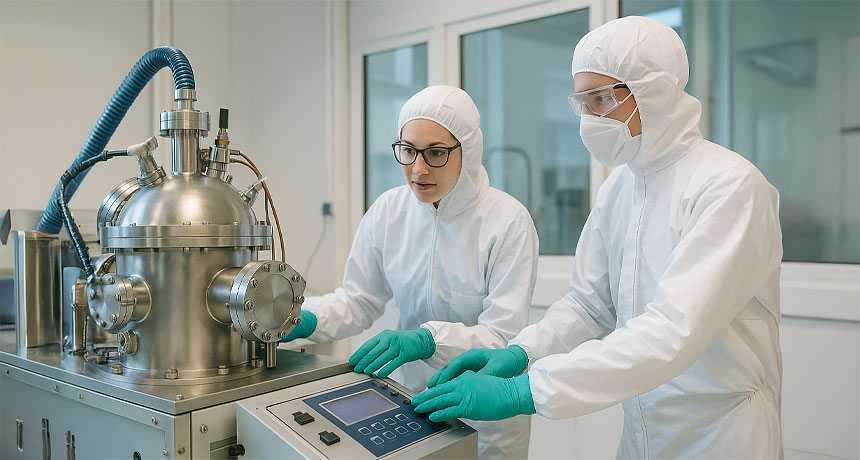
The Role of Vacuum in Nanotechnology Manufacturing
Nanotechnology, the science of manipulating matter at the atomic or molecular scale, has rapidly transformed a wide range of industries, from electronics and medicine to energy and materials science. As components shrink to the scale of nanometers—one billionth of a meter—precision and cleanliness become paramount. In this ultra-sensitive world, even a single stray molecule can cause defects. That’s where vacuum technology comes in.
Vacuum environments are essential in nanotechnology manufacturing, enabling precise fabrication, enhanced material properties, and contamination-free processing. This article explores how vacuum systems make nanotechnology possible, which vacuum techniques are used, and how manufacturers can optimize vacuum setups to keep pace with today’s nanoscale demands.
Why Nanotechnology Needs Vacuum
1. Contamination Control
Nanofabrication is extremely sensitive to airborne contaminants. A single particle or molecule of water vapor can alter surface chemistry, inhibit adhesion, or cause defects in critical layers. A high or ultra-high vacuum (UHV) environment removes such contaminants and enables cleaner, more reproducible processes.
2. Surface Interaction and Deposition
Processes like thin-film deposition, atomic layer deposition (ALD), and molecular beam epitaxy (MBE) require atom-level control. These techniques rely on vacuum chambers to:
- Control deposition rates
- Ensure uniformity across wafers or substrates
- Prevent unwanted chemical reactions with ambient gases
3. Ion and Electron Beam Processes
Electron beam lithography (EBL) and focused ion beam (FIB) systems require high vacuum environments to operate effectively. Vacuum ensures that the beam’s path is not deflected or absorbed by stray gas molecules, enabling precise patterning and etching at sub-10nm resolution.
Common Vacuum-Enabled Nanotech Processes
1. Physical Vapor Deposition (PVD)
PVD includes techniques like sputtering and evaporation, which are essential for depositing metal, semiconductor, or dielectric layers onto substrates. These processes require high vacuum (10⁻⁴ to 10⁻⁷ mbar) to minimize gas-phase collisions and ensure purity of deposited materials.
2. Chemical Vapor Deposition (CVD)
Though not always done under high vacuum, low-pressure CVD (LPCVD) is common in nanotech. It offers improved film quality and step coverage for nanostructures. High vacuum systems help regulate gas flow and reaction kinetics precisely.
3. Atomic Layer Deposition (ALD)
ALD offers sub-nanometer control over film thickness, making it ideal for coating 3D nanostructures. Vacuum ensures that precursor gases are introduced sequentially and don’t overlap, maintaining the self-limiting nature of the reaction.
4. Etching and Patterning
Reactive ion etching (RIE) and other plasma-based etching techniques rely on controlled vacuum chambers to generate plasmas and manage ion energies. These processes are essential for sculpting nanostructures with sharp features and smooth sidewalls.
5. Nanoprinting and Nanoimprint Lithography
These techniques apply mechanical stamping or optical curing methods to create nanostructures. Vacuum may be used to remove trapped air between templates and substrates or to cure resists uniformly.
Vacuum System Requirements in Nanofabrication
1. Cleanliness and Outgassing
Materials used inside vacuum chambers—gaskets, feedthroughs, adhesives—must be low-outgassing to prevent contamination. Stainless steel chambers, ceramic insulators, and metal seals are common choices.
2. Pressure Range
Most nanofabrication processes operate between high vacuum (10⁻³ mbar) and UHV (10⁻⁹ mbar). The system must support:
- Multiple pressure regimes
- Fast pump-down times
- Consistent vacuum stability
3. Pump Selection
Vacuum systems typically combine several pumps:
- Roughing pumps: Scroll or diaphragm pumps for initial pump-down.
- High vacuum pumps: Turbomolecular or diffusion pumps for clean, oil-free vacuum.
- Backing pumps: Rotary vane or dry pumps to support high vacuum pumps.
- UHV systems: Use ion pumps or cryopumps for extended low-pressure operation.
4. Vacuum Gauges and Controls
Precision gauges are critical for nanotech applications, including:
- Pirani gauges for medium vacuum
- Cold cathode or hot cathode ion gauges for UHV
- Capacitance manometers for accurate process control
Vacuum controllers and automation systems ensure tight regulation and fast cycling for process throughput.
Challenges and Considerations
1. Cost and Complexity
UHV systems are expensive to build and maintain. Design decisions must balance performance and budget, especially for multi-chamber production lines.
2. System Integrity
Leaks, backstreaming of pump oil, or outgassing can degrade vacuum quality. Regular maintenance and the use of dry pumps or traps help mitigate these issues.
3. Throughput vs. Purity
In high-volume manufacturing, maintaining ultra-clean environments while ensuring process speed requires well-optimized pump and valve configurations, as well as robust control systems.
Applications of Nanotechnology Made Possible by Vacuum
- Semiconductor Devices: Gate oxides, transistors, and interconnects at 5nm nodes and below depend on ALD and PVD processes made possible only in vacuum.
- MEMS and NEMS: Micro and nanoelectromechanical systems use vacuum deposition and etching to define complex moving parts on the nanoscale.
- Quantum Devices: Quantum dots, superconducting qubits, and other next-generation devices require pristine fabrication environments to prevent decoherence and defects.
- Advanced Coatings: Nanocoatings for wear resistance, antibacterial properties, and optical behavior (e.g., anti-reflective or self-cleaning glass) are typically deposited in vacuum environments.
Designing a Vacuum System for Nanotechnology
A properly designed vacuum system isn’t just about achieving low pressure—it’s about doing so reliably, cleanly, and in sync with other equipment. Key design tips include:
- Modular design: Separate load-lock and process chambers to maintain cleanliness.
- Bake-out procedures: Heat the system to desorb water and volatiles before use.
- Real-time monitoring: Integrate pressure gauges and RGA (residual gas analyzers) for feedback control.
- Preventative maintenance: Clean filters, replace seals, and inspect pumps regularly.
Conclusion
Vacuum technology plays a central role in enabling the precision, cleanliness, and control required for nanotechnology manufacturing. From thin film deposition to etching and lithography, nearly every stage of nanofabrication relies on maintaining stable vacuum conditions tailored to specific process needs.
As the industry continues to push the limits of miniaturization, vacuum systems must evolve in complexity and performance. At High Vac Depot, we specialize in designing and supporting vacuum systems that meet the demanding needs of nanotech manufacturers.
Have questions about outfitting or optimizing your vacuum system for nanoscale production? Contact the experts at High Vac Depot today and get the support you need to build smarter, cleaner, and more efficient nanofabrication processes.




Leave a Reply
You must be logged in to post a comment.