


How Vacuum Technology Supports Quantum Computing Development
Quantum computing is often discussed in terms of qubits, error correction, cryogenics, and exotic materials. Those subjects deserve the attention, but they can make it easy to overlook the support systems that allow quantum devices to be fabricated, tested, and operated in the first place. Vacuum technology is one of those support systems. It is not a side detail. It is part of the foundation that makes many quantum computing platforms possible.
Different quantum architectures use vacuum in different ways. Superconducting qubits depend heavily on vacuum-based thin-film deposition and cryogenic insulation. Trapped-ion and neutral-atom systems require ultra-clean, extremely low-pressure environments to isolate atoms or ions from unwanted collisions. Quantum materials research depends on vacuum chambers that can grow, clean, transfer, and measure sensitive surfaces without exposing them to contamination. Across all of these areas, vacuum helps researchers control the environment around systems that are easily disturbed.
High Vac Depot’s article on how superconducting materials are affecting vacuum applications is directly relevant here because many quantum computing approaches depend on superconducting films, cryogenic systems, and careful contamination control. Quantum computing may be a cutting-edge field, but the vacuum requirements behind it are grounded in familiar engineering concerns: clean surfaces, low gas loads, stable pressure, reliable measurement, and leak-tight hardware.
Vacuum in superconducting qubit fabrication
Superconducting qubits are commonly built from carefully patterned thin films and Josephson junctions. These structures are extremely sensitive to material quality, interface condition, oxidation, residue, and film uniformity. A small defect or contaminated interface can contribute to energy loss, shorten coherence time, or reduce device consistency across a wafer.
Vacuum deposition is central to this fabrication work. Techniques such as sputtering, electron-beam evaporation, and other physical vapor deposition methods allow superconducting metals and related materials to be deposited under controlled conditions. High Vac Depot’s article on vacuum solutions for thin film deposition explains many of the same process concerns that apply to quantum hardware: chamber cleanliness, pump selection, pressure stability, and control of residual gases.
In superconducting device fabrication, vacuum quality affects more than whether a film can be deposited. It affects the film’s density, adhesion, grain structure, impurity content, and interface behavior. For quantum devices, those details are not minor. They can influence how long a qubit maintains its state and how repeatable the device is from one fabrication run to the next.
Contamination control and surface sensitivity
Quantum devices are often limited by surfaces and interfaces. A superconducting film may look clean to the naked eye while still carrying oxides, hydrocarbons, water layers, resist residue, or other contamination that can create loss mechanisms at cryogenic temperatures. Because quantum systems operate with very small energy scales, contamination that would be tolerable in a less sensitive device can become a performance problem.
This is where vacuum discipline becomes critical. Chamber cleaning, material selection, pump type, venting practice, and handling procedures all influence surface condition. High Vac Depot’s article on outgassing and why it matters is especially relevant for quantum research because outgassed water vapor, solvents, polymers, elastomers, and hydrocarbons can end up on surfaces that later become part of a quantum device.
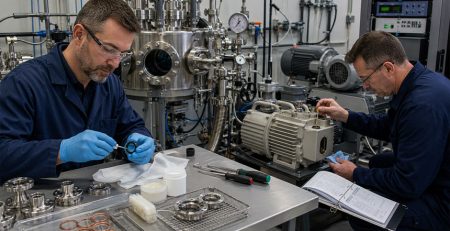
Backstreaming is another concern. In sensitive systems, oil vapor from pumping equipment can contaminate chambers and substrates if the vacuum architecture is not designed carefully. For that reason, many research and fabrication environments prefer oil-free roughing options such as dry scroll pumps or use traps, isolation valves, and clean foreline practices to reduce hydrocarbon risk.
Contamination control is not only about keeping a chamber visibly clean. It is about preventing molecular-level changes that may not be obvious until a device is measured at cryogenic temperature.
Cryogenic vacuum and thermal isolation
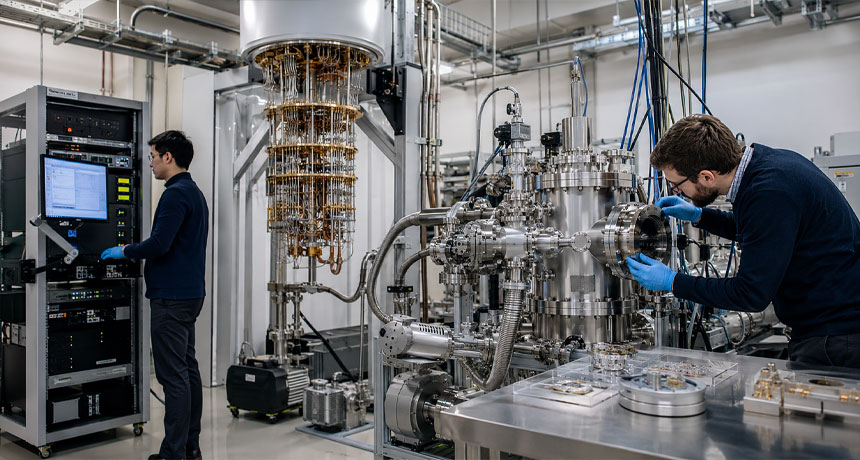
Many quantum computing systems, especially superconducting and spin-based approaches, must operate at extremely low temperatures. Dilution refrigerators are used to cool quantum processors to millikelvin-range conditions. Vacuum plays a major role in these systems by reducing convective heat transfer and helping cold stages remain cold.
In a cryogenic system, vacuum is part of the insulation strategy. Without a good insulating vacuum, residual gas molecules would carry heat from warmer structures to colder stages, increasing the thermal load on the refrigerator. That makes it harder to reach base temperature, harder to maintain stability, and harder to support the wiring, shielding, and hardware needed for larger quantum systems.
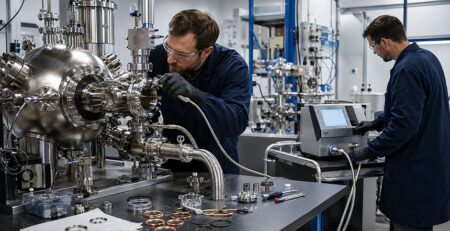
The vacuum space around a cryostat also has to remain reliable over long operating periods. A leak, outgassing source, poor seal, or contaminated component can increase heat load or create operational instability. High-vacuum hardware choices matter here. CF flanges and fittings are often used where metal seals, low leak rates, and bakeability are important. Elastomer-sealed hardware may still be useful in some sections, but the seal choice must match the pressure, temperature, cleanliness, and service requirements of the system.
Vacuum for trapped-ion and neutral-atom systems
Not all quantum computers are based on superconducting circuits. Trapped-ion and neutral-atom platforms also rely heavily on vacuum, but for a different reason. These systems need to isolate individual atoms or ions from collisions with background gas molecules. If the pressure is too high, collisions can disturb the quantum state, heat the trapped particles, or knock particles out of the trap entirely.
That means ultra-high vacuum is not just desirable. It is part of the operating principle. The vacuum system must support long trapping times, low collision rates, and stable optical or electromagnetic control conditions. This often requires careful chamber design, low-outgassing materials, metal seals, bakeout compatibility, ion pumping, getter pumping, and reliable pressure measurement.
High Vac Depot’s article on the use of vacuum in high-energy physics research covers a similar principle in another field: when particles must travel or remain isolated without unwanted collisions, vacuum quality becomes part of the experiment itself. In quantum computing, that principle applies at the scale of atoms and ions.
Pumping architecture for quantum research systems
Quantum computing development does not rely on one universal vacuum system. A thin-film deposition tool, a dilution refrigerator, a trapped-ion chamber, and a surface-analysis system all have different pumping needs. Even so, the same design question appears again and again: what pressure does the application need at the location that matters?
A pump’s rated speed is only one part of the answer. Conductance, chamber volume, line geometry, gas load, and pump placement all affect delivered performance. High Vac Depot’s article on vacuum level and pumping speed is useful for understanding why a strong pump can still underperform if the vacuum path is restrictive.
In many research systems, roughing pumps bring the system down from atmosphere, then high-vacuum pumps take over. Turbo pumps are commonly used where clean high-vacuum performance and fast pump-down are needed. Ion pumps, getter pumps, and cryopumping effects may be used in systems where ultra-low gas loads and quiet long-term operation are priorities.
The best architecture depends on the application. A deposition chamber may prioritize clean pump-down and process gas handling. A trapped-ion chamber may prioritize ultra-low base pressure and long-term stability. A cryostat vacuum space may prioritize thermal insulation and leak reliability. A surface-preparation chamber may prioritize transfer cleanliness and compatibility with heating, sputtering, or analysis tools.
Pressure measurement and leak integrity
Quantum development systems need trustworthy pressure measurement. A gauge that works well for roughing may not provide useful data at high vacuum. A high-vacuum gauge may be inappropriate during early pump-down. A sensor mounted near the pump may not represent the pressure near the device, trap, or substrate.
The right vacuum gauges help researchers monitor the pressure range that actually matters. For high-vacuum and ultra-high-vacuum work, ionization-based gauges are often part of the measurement strategy. Gauge placement, calibration, contamination exposure, and controller integration all affect the value of the reading.
Leak integrity is just as important. A small leak can introduce water vapor, oxygen, nitrogen, and other contaminants that are harmful to clean films, cold surfaces, and trapped particles. In some cases, the problem appears as poor base pressure. In others, it appears as inconsistent device performance or poor chamber recovery after maintenance.
High Vac Depot’s leak detectors can help research and engineering teams verify chamber integrity, feedthrough seals, welds, valves, cryostat spaces, and custom assemblies. For teams that only need short-term diagnostic capability, helium leak detector rental can be a practical way to confirm leak-tight performance without purchasing equipment outright.
Custom chambers, fixtures, and research hardware
Quantum computing development often requires hardware that does not fit neatly into standard catalog categories. A lab may need a compact UHV chamber for ion trapping, a custom deposition fixture for superconducting films, a specialized feedthrough arrangement for cryogenic wiring, or a transfer interface that preserves surface cleanliness between tools.
This is where vacuum engineering becomes application-specific. Port placement, material selection, weld quality, access geometry, serviceability, and pump integration all affect whether the system performs as intended. The best design is rarely the one with the most components. It is the one that gives the experiment the pressure, cleanliness, access, and stability it needs without adding unnecessary leak paths or trapped volumes.
High Vac Depot’s custom fabrication resources are relevant for research teams that need purpose-built chambers, adapters, manifolds, or hardware. High Vac Depot’s consulting support can also help teams think through pump selection, system layout, gauge strategy, and troubleshooting before small design decisions become expensive problems.
For early planning work, High Vac Depot’s calculators can help engineers think through vacuum behavior such as conductance, pump-down, gas load, and unit conversions. These tools do not replace detailed system design, but they help frame practical questions before hardware is purchased or modified.
Conclusion
Vacuum technology supports quantum computing development in several important ways. It enables thin-film deposition for superconducting circuits, protects sensitive surfaces from contamination, provides thermal insulation in cryogenic systems, supports ultra-high vacuum for trapped-ion and neutral-atom platforms, and gives researchers the controlled environments needed to build and test fragile quantum devices.
As quantum systems become larger and more demanding, vacuum design becomes even more important. Pump selection, chamber cleanliness, seal strategy, leak testing, gauge placement, material choice, and custom hardware all influence whether a system can deliver stable, repeatable performance.
If your work involves quantum research, superconducting devices, cryogenic systems, thin-film deposition, UHV chambers, or vacuum troubleshooting, contact the experts at High Vac Depot. The team can help you select pumps, gauges, fittings, leak detection equipment, custom hardware, and system-level solutions that support the performance your application requires.




Leave a Reply
You must be logged in to post a comment.