


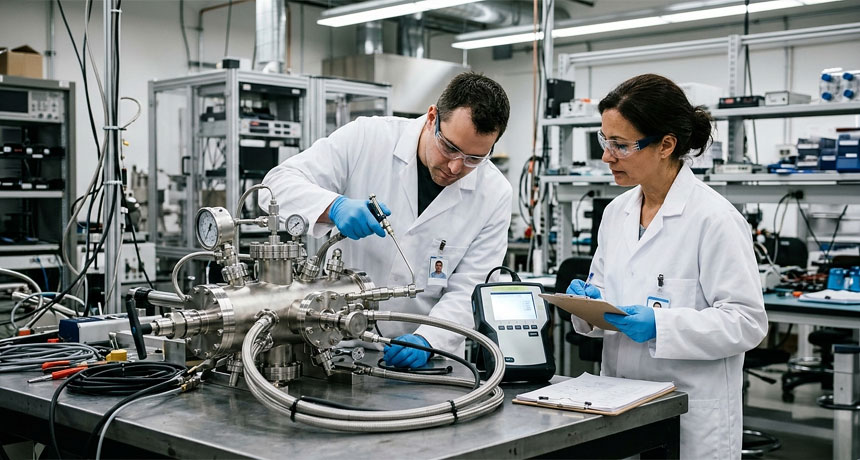
How to Design a Leak-Free Vacuum System
“Leak-free” in vacuum engineering usually means two things: (1) no real leaks to atmosphere (or between isolated volumes), and (2) no hidden gas sources inside the system that behave like leaks (virtual leaks, permeation, outgassing, backstreaming, and trapped volumes). Most vacuum “leak problems” are actually a mix of design choices, assembly practice, and material behavior—so the best time to solve them is at the design stage, not after the system is built.
This guide walks through a practical, engineering-first approach to designing a vacuum system that seals reliably, pumps down predictably, and stays tight over time.
Start with the right definition of “leak” (real leak vs. gas load)
Before you redesign hardware, separate these categories:
- Real leaks: a physical path from atmosphere into the vacuum space (bad seals, cracked welds, loose fittings, pinholes, damaged O-rings).
- Virtual leaks: trapped volumes or porous paths that slowly feed gas into the chamber (blind tapped holes, overlapped plates, poor weld geometry).
- Outgassing/permeation: gas coming off surfaces or diffusing through elastomers.
- Backstreaming / carryover: pump fluid vapors or process vapors migrating into the chamber.
If you treat every pressure problem as a “leak,” you’ll chase the wrong fix. A genuinely leak-free system still has a gas load—the goal is to minimize it and make it predictable.
Design the layout around conductance and sealing simplicity
A leak-free system is easier to build when it’s simple. Every joint is a risk point, and every restriction increases pumpdown time, which tempts people to overtighten seals or “try one more gasket,” creating new problems.
Key layout principles:
Keep lines short, straight, and appropriately sized
Conductance is often the hidden limiter. If your plumbing is long and narrow, a bigger pump may not help—and the system may spend more time in “problem” pressure ranges where seals and trapped volumes show up. A clear overview of this is explained in this conductance primer.
A simple rule of thumb: if you double pump speed but the line conductance stays the same, the chamber may only pump down marginally faster—especially once you transition toward molecular flow. In those cases, money is often better spent on larger diameter plumbing, shorter lines, fewer restrictions, or a different system layout than on a bigger pump.
Minimize joints and adapters
Every reducer, elbow, and adapter adds:
- more sealing surfaces,
- more trapped volume opportunities,
- more places for particulate to compromise a seal.
Where possible, standardize on a small set of interface families (KF for modular lab setups, ISO/CF for higher vacuum and bakeable assemblies), and avoid chaining multiple adapter types.
Put isolation and venting where they belong
A “leak-free” system is also one you can operate safely: isolate the chamber, isolate the pump, vent deliberately, and avoid accidental reverse flow. Valve selection is central here, and you can browse common options in the vacuum valves section.
Choose connection hardware that matches your vacuum level and temperature
Your required base pressure and operating environment determine which sealing technologies make sense.
KF (NW/QF) connections for modular, serviceable systems
KF hardware is popular because it’s fast, modular, and great for lab-scale and many high-vac applications (within its normal use envelope). The tradeoff is that KF relies on elastomer sealing and clamp quality, so design must prevent side-loading and misalignment.
Relevant hardware families include KF flanges and fittings and broader hardware and fittings used across vacuum systems.
Metal-sealed flanges for UHV and high-temperature bakeout
If you are operating at high bakeout temperatures or aiming for ultra-high vacuum, metal seals and knife-edge styles typically reduce permeation risk and improve cleanliness. Even then, flange condition, torque practice, and alignment are everything.
Eliminate trapped volumes and virtual leak geometries
Virtual leaks are design-created problems. The system can be “sealed,” but trapped gas slowly bleeds into the vacuum space and looks like a mysterious leak. If you want a deeper explanation and examples, see this guide to virtual leaks.
Common design traps (and fixes):
- Blind tapped holes into vacuum: use vented screws, vent grooves, or through-holes where possible.
- Overlapped plates and sandwich geometries: add vent paths so trapped pockets can evacuate.
- Poor weld joints: avoid crevices and incomplete penetration features that create trapped volumes.
- Threaded fittings used improperly: consider face-seal designs or use proper thread seal strategy (and keep sealant out of vacuum space).
If you suspect a virtual leak during design review, treat it like a real leak—because it will behave like one during pumpdown and rate-of-rise tests.
Select seals and elastomers with vacuum reality in mind
Elastomers are often the weak link in “leak-free” systems, not because they’re bad, but because they’re frequently misapplied.
O-ring best practices
- Use the correct gland geometry (compression, squeeze, stretch, and clearance matter).
- Avoid twisting and abrasion during assembly.
- Protect from particulate and scratches—tiny debris can create a leak path.
- Don’t over-tighten flanges to “fix” a leak; it often distorts the seal.
Grease: sometimes helpful, often harmful
Vacuum grease can help in specific cases (like lightly assisting an O-ring seal), but it can also trap contaminants, migrate, and become a contamination source—especially in cleaner systems. If grease is part of your practice, be deliberate about when and how you use it, and review these grease-related considerations before making it your default.
Build in the ability to test: leak detection ports, isolation, and baselining
A leak-free system isn’t just well-built—it’s testable.
Design for isolation testing
Include valve placement that lets you:
- isolate the chamber from the pump,
- isolate sections (foreline vs chamber),
- run controlled rate-of-rise tests.
This allows you to quickly determine whether pressure rise is due to:
- a real leak,
- outgassing,
- or internal trapped volumes.
Include the right fittings for helium leak testing
If helium leak testing is part of your workflow, plan ports and adapters that make it easy to connect the detector properly and avoid awkward temporary plumbing. You can explore typical equipment in the leak detector category.
If you need to verify or calibrate a detector as part of QA, a calibrated leak standard can be a valuable part of your workflow.
Use pumpdown behavior as a design feedback tool
Your system’s pumpdown curve is not just an operational detail—it’s a diagnostic signature. When designing for “leak-free,” you want predictable behavior across cycles.
- If pumpdown is fast initially and then stalls high, you may be conductance-limited or outgassing-dominated.
- If pressure rises quickly when isolated, suspect a real leak.
- If pressure rises slowly and nonlinearly, suspect outgassing or virtual leaks.
For quick checks and helpful calculators that support engineering estimates, see the vacuum calculators page.
Control venting and human factors to prevent “operator-caused leaks”
A perfect design can still be defeated by how people vent, service, and reassemble the system. Design for clean serviceability:
- Provide clear vent points and vent procedures (slow venting reduces particulate ingestion and mechanical stress). If you need practical guidance, review these venting methods.
- Use alignment features (dowel pins, locating shoulders, symmetric clamp placement) so flanges seat consistently.
- Make seals accessible and inspectable—if an O-ring requires heroic disassembly, it won’t get inspected when it should.
Practical checklist for a leak-free design review
Before release, run this checklist:
- Vacuum level and temperature defined (including bakeout and hot spots)
- Interface family standardized (KF / ISO / CF) with minimal adapters
- All joints are accessible for inspection and re-torque
- No blind tapped holes into vacuum without venting strategy
- No trapped volumes in welds, overlaps, or sandwich assemblies
- Correct seal selection (elastomer vs metal seal)
- Proper valve placement for isolation and testing
- Leak detection connection planned (ports, fittings, and workflow)
- Venting approach defined and safe for operators and hardware
- Baseline test plan: rate-of-rise, helium sniffing/spray, and acceptance criteria
Conclusion
Designing a leak-free vacuum system is less about “finding the magic gasket” and more about engineering discipline: simple layouts, good conductance, the right flange and seal choices, elimination of trapped volumes, and built-in testability for helium leak detection and isolation checks. When you address virtual leaks, sealing geometry, venting strategy, and service access at the design stage, you dramatically reduce troubleshooting time and improve long-term reliability. If you’d like help selecting the right hardware, valves, fittings, and leak detection approach for your specific vacuum level and application, contact the experts at High Vac Depot—start with vacuum system consulting or reach out directly through the contact page.








Leave a Reply
You must be logged in to post a comment.