


Why Foreline Pressure Matters in Turbomolecular Pump Systems
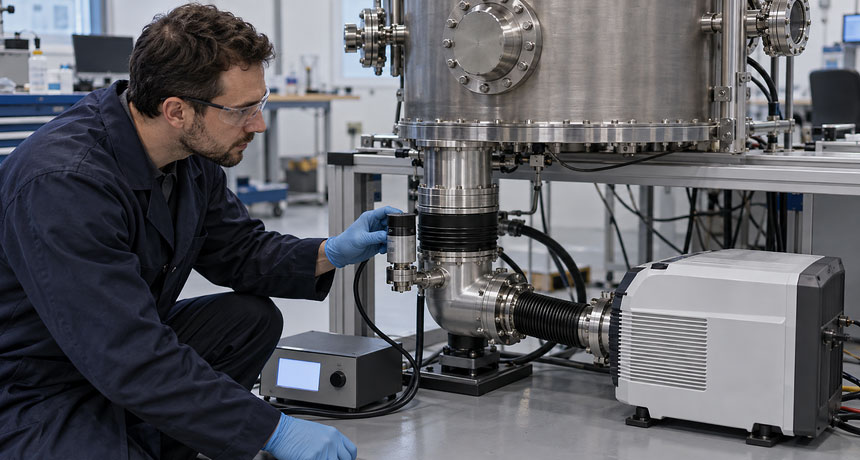
A turbomolecular pump may be the component that produces high vacuum, but it cannot do the job alone. Every turbomolecular pump must discharge into a foreline that is continuously evacuated by a backing pump. If pressure on that outlet side rises too far, the turbo may run hot, lose compression, take longer to reach speed, or shut down even when the pump itself is mechanically sound.
Foreline pressure is therefore one of the most useful health indicators in a high-vacuum system. It connects the chamber’s gas load, the turbopump’s operating condition, the backing pump’s capacity, and the conductance of the piping between them. Watching that pressure as a trend, rather than as a single pass-or-fail number, can expose problems before the chamber pressure becomes unacceptable.
What foreline pressure actually measures
The foreline is the low-vacuum connection between the turbopump exhaust and the backing pump inlet. Foreline pressure, sometimes called backing pressure, is the pressure in that connection while the system is operating. It is not the same as chamber pressure, and it should be measured near the turbopump exhaust whenever practical. A gauge at the backing pump inlet may read differently if a long hose, small fitting, filter, or partly closed valve creates a pressure drop.
The turbo transfers gas from its high-vacuum inlet to this foreline. The backing pump then carries that gas to atmosphere. A well-matched system keeps the foreline below the turbo manufacturer’s allowable limit across normal startup, process flow, and chamber recovery. That limit is model-specific, so the pump manual and controller settings always take priority over a generic rule of thumb.
Why the turbopump depends on the backing stage
A turbopump compresses gas by transferring momentum from rapidly rotating blades to gas molecules. Its compression ratio describes how much higher the partial pressure can be at the exhaust than at the inlet. As foreline pressure increases, the pressure that can be maintained at the high-vacuum side also tends to increase. The effect varies by gas species because light gases such as hydrogen and helium are harder to compress than heavier gases.
Many modern pumps add a molecular-drag stage to increase allowable backing pressure and improve compression. That design advantage does not eliminate the backing requirement. An Edwards nEXT 85, for example, still needs an appropriate backing pump and control strategy. For more background on the added exhaust stage, see Understanding Molecular Drag Pumps and Their Applications.
Common reasons foreline pressure rises
A rising foreline pressure does not automatically mean the turbo needs repair. It means the amount of gas entering the foreline is greater than the backing system can remove at that moment. The most common causes are practical and testable:
- The backing pump is undersized for the actual gas load. A pump chosen only by ultimate pressure may lack enough pumping speed at the system’s normal foreline pressure. Start with the same throughput logic used when properly sizing a vacuum system.
- The foreline is too restrictive. Long tubing, small inside diameter, multiple elbows, clogged traps, and undersized KF flanges and fittings reduce delivered pumping speed even when the backing pump’s nameplate rating looks adequate.
- The backing pump has lost performance. Worn seals, contaminated oil, damaged tip seals, blocked inlet screens, or overdue service can all raise operating pressure.
- The process is adding more gas or vapor than expected. Leaks, outgassing, purge flow, solvent vapor, and rapid chamber cycling can create short peaks or a sustained load.
- The system sequence or valve position is wrong. A closed, throttled, or slow-opening vacuum valve can isolate the backing pump or add enough restriction to trigger a turbo warning.
Measure the pressure where it matters
A thermal-conductivity gauge is a common choice for the foreline range. Pirani gauges are compact and cover much of the pressure range encountered during roughing and turbo operation, but their response depends on gas composition. A reading calibrated for nitrogen can shift when the process gas changes, so unexplained movement should be compared with the process recipe and gauge documentation.
Install the sensor close enough to the turbopump exhaust to represent the pressure the pump actually sees. Avoid a long dead-ended branch, and confirm that isolation valves cannot leave the gauge measuring a trapped volume. When the turbo controller provides speed, motor current, or temperature, trend those values with foreline and chamber pressure. A pressure rise paired with increasing current or temperature is more informative than any one reading alone.
Design the foreline as part of the pumping system
Choose the backing pump for the required throughput at operating pressure, not simply for its lowest advertised ultimate pressure. Dry scroll pumps are common in clean laboratory systems, while rotary vane pumps provide strong roughing performance where oil-sealed operation is acceptable. Diaphragm pumps may suit smaller turbopumps or lighter gas loads when their performance matches the turbo manufacturer’s requirement. For corrosive or condensable service, verify material compatibility and vapor-handling features as well as speed. The best choice is the combination whose published operating curve covers both normal load and worst-case startup.
Keep the foreline short and generously sized. Use clean components, fully open valves, secure clamps, and correctly seated centering rings. A factory-integrated turbo pump station can simplify matching and sequencing, but custom systems can perform just as well when the turbo, backing pump, gauge, controller, and plumbing are treated as one pumping train.
A practical troubleshooting sequence
- Check the turbo manual for the allowable foreline pressure, required backing speed, interlock thresholds, and permitted startup sequence.
- Record chamber pressure, foreline pressure, rotor speed, motor current, temperature, and process state. Compare the trend with a known-good run.
- Reduce or stop process gas flow. If foreline pressure falls promptly, investigate gas load, leaks, vapor, or recipe changes before blaming the pump.
- Inspect the foreline for closed valves, collapsed or contaminated hose, clogged traps, small adapters, loose clamps, and damaged seals.
- Test the backing pump independently at its inlet. Confirm that it reaches the expected pressure and recovers after a controlled gas load.
- If backing performance remains poor after routine maintenance, arrange a vacuum pump rebuild or service evaluation before the weak backing stage causes repeated turbo trips.
Treat foreline pressure as an early warning
Foreline pressure is not a secondary detail. It is the working interface between the high-vacuum pump and the roughing stage. A stable baseline confirms that gas throughput, backing capacity, and line conductance are in balance. A rising trend gives the operator a focused place to investigate before high-vacuum performance deteriorates.
High Vac Depot can help match turbo pumps, backing pumps, gauges, controllers, valves, and fittings for a complete system, or help diagnose a foreline that is limiting existing equipment. Contact the High Vac Depot team for help selecting components or diagnosing foreline pressure problems in your turbomolecular pumping system.







Leave a Reply
You must be logged in to post a comment.