


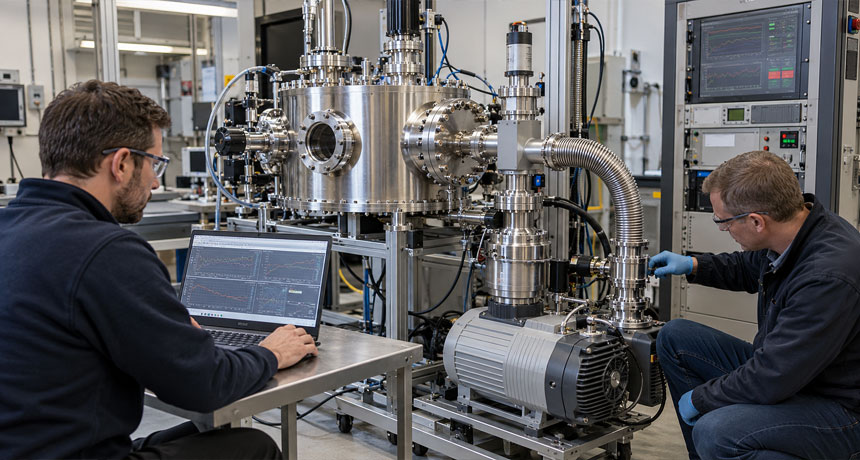
How the Internet of Things (IoT) is Changing Vacuum System Maintenance
Vacuum-system maintenance has traditionally been based on a combination of scheduled service intervals, operator experience, and troubleshooting after performance begins to decline. That approach still has value, but connected sensors and equipment are changing how maintenance decisions are made. The Internet of Things, or IoT, allows vacuum pumps, gauges, controllers, and related equipment to collect operating data continuously and make that information available to technicians, engineers, and maintenance teams.
In practical terms, IoT turns a vacuum system from equipment that is periodically inspected into equipment that can continuously report on its own condition. Pressure trends, pump temperature, motor load, vibration, operating hours, energy use, alarms, and service status can all become part of the maintenance picture.
That does not eliminate technicians or traditional maintenance. It gives them better information. Instead of relying only on a calendar, facilities can begin making maintenance decisions based on how the system is actually operating.
From scheduled maintenance to condition-based maintenance
Traditional preventive maintenance usually follows a fixed schedule. Oil is changed after a certain number of hours. Tip seals are replaced at a recommended interval. Bearings are serviced according to the manufacturer’s schedule. These intervals are important because they establish safe maintenance expectations, but they cannot account perfectly for every application.
Two identical pumps may experience very different operating conditions. One may handle clean, dry gas eight hours a day. Another may run continuously while processing water vapor, solvents, dust, or other contaminants. Treating both pumps as though their maintenance needs are identical can result in unnecessary service on one and delayed service on the other.
IoT-based monitoring makes condition-based maintenance more practical. Instead of asking only, “How many hours has this pump run?” a maintenance team can also ask:
- Is operating temperature increasing?
- Is vibration changing?
- Is pump-down time getting longer?
- Has power consumption increased?
- Is ultimate pressure slowly degrading?
- Are faults becoming more frequent?
- Is foreline pressure changing under the same process load?
Those trends can provide earlier warning that a pump or component is beginning to deteriorate.
High Vac Depot’s pump rebuild service remains important when equipment reaches the point where service is actually required. Connected monitoring simply helps users recognize that point sooner and plan the intervention more intelligently.
Pressure data becomes more useful when it is trended
A single pressure reading tells you what the system is doing at one moment. A pressure trend tells you how the system behaves over time.
That distinction is important.
Suppose a chamber normally reaches 1 × 10⁻⁵ Torr in 18 minutes. If that pump-down time gradually increases to 21, then 25, then 30 minutes over several weeks, something has changed. The cause could be pump wear, contamination, a developing leak, increased outgassing, a restricted line, or a process change.
Without stored data, the change may be subtle enough to go unnoticed. With IoT-enabled logging, the trend becomes visible.
The same principle applies to base pressure. A system that gradually stabilizes at a higher pressure from one cycle to the next may be showing early signs of deterioration even if it has not yet triggered an alarm.
Reliable vacuum gauges are therefore an important part of connected maintenance. The sensor provides the data, while the connected controller or supervisory system makes it possible to store, compare, and analyze that data over time.
High Vac Depot’s article on why calibration matters for vacuum sensors is especially relevant here. Collecting thousands of data points is not useful if the sensor producing them has drifted significantly out of calibration.
Connected controllers bridge vacuum equipment and plant systems
Modern vacuum controllers increasingly include analog outputs, digital communications, relay outputs, or industrial networking options that make integration easier.
For example, the Televac MX200 gauge controller can monitor multiple vacuum gauges while providing analog outputs and digital communication options for integration with computers or PLCs. That kind of architecture allows vacuum measurements to become part of a larger control and monitoring system rather than remaining isolated on a local display.
Once information reaches a PLC, data acquisition system, industrial PC, or network gateway, it can be logged alongside other equipment variables. Pressure can be compared with valve position, pump status, temperature, process gas flow, or production cycle.
This is where IoT becomes more useful than simply putting a gauge reading on a phone. The real value is context.
If chamber pressure rises while a valve remains closed, that information means something different from pressure rising immediately after a process gas valve opens. If motor current rises while pump-down time also increases, the combination may point toward a developing mechanical or process problem.
Connected maintenance works best when multiple variables can be compared rather than interpreted one at a time.
Predictive maintenance uses patterns, not just alarms
Traditional equipment alarms are reactive. A temperature limit is exceeded, a motor trips, or pressure rises above a set point, and the system generates a fault.
Predictive maintenance tries to identify deterioration before that threshold is reached.
For vacuum equipment, useful predictive variables can include:
- Pump temperature
- Vibration
- Motor current
- Energy consumption
- Pump speed
- Operating hours
- Pump-down time
- Base pressure
- Foreline pressure
- Valve cycles
- Alarm history
No single variable always predicts failure. The value comes from identifying patterns.
For example, rising vibration by itself may not justify removing a pump from service. But increasing vibration combined with higher operating temperature and a change in motor current creates a stronger indication that mechanical condition is changing.
Similarly, a slight change in base pressure may not be alarming. If the same system also shows progressively slower pump-down, the maintenance team has more reason to investigate.
IoT systems can make those patterns easier to see because the data is captured continuously instead of relying on occasional manual readings.
Remote monitoring changes how facilities respond to problems
One of the most visible IoT benefits is remote access.
A connected vacuum system can potentially report status even when the engineer responsible for it is not standing next to the equipment. Depending on the controller and monitoring platform, a user may be able to review operating conditions, receive alarms, inspect trends, or determine whether a pump is running before traveling to the equipment.
This is particularly useful for:
- Facilities with multiple vacuum systems
- Equipment operating overnight or on weekends
- Remote research installations
- Production lines with centralized maintenance teams
- Systems located in cleanrooms or controlled areas
- OEM equipment supported from another location
Remote access can also improve troubleshooting. Instead of receiving a call that “the vacuum is bad,” a technician may be able to review pressure history, operating hours, controller faults, and temperature trends before opening the machine.
High Vac Depot’s guide to troubleshooting common vacuum-system issues provides a useful framework for interpreting those symptoms. IoT monitoring does not replace troubleshooting knowledge; it gives the technician more evidence to work with.
IoT can expose maintenance problems before production stops
Unexpected vacuum failure is expensive because the pump itself is rarely the only cost. Production may stop. A coating run may be lost. Samples may be compromised. An analytical instrument may become unavailable. A research experiment may have to be repeated.
Connected monitoring can help move some failures from the “unexpected” category into the “planned” category.
Consider a dry scroll pump used as a backing pump on an analytical instrument. As tip seals wear, performance can gradually decline. If pump-down time and foreline pressure are being trended, the decline may become apparent before the pump can no longer support the high-vacuum stage.
A similar idea applies to rotary vane pumps. Changes in ultimate pressure, temperature, operating current, or pump-down behavior may support maintenance decisions alongside visual inspection of oil condition and normal service intervals.
For turbo pumps, controller data can be especially valuable because rotor speed, temperature, current, fault history, and backing conditions can all influence reliability.
Connected maintenance improves spare-parts planning
Maintenance planning is not just about knowing when equipment needs attention. The right parts also have to be available.
If trends indicate that a pump is approaching service, maintenance teams have time to obtain oil, seals, filters, tip seals, rebuild kits, or replacement equipment before shutting the system down.
High Vac Depot’s maintenance products include oils, filters, rebuild kits, and related service items for vacuum equipment. Using condition data to plan those purchases can reduce emergency ordering and shorten downtime.
It can also help facilities manage multiple pumps more intelligently. Instead of servicing ten pumps simply because they reached the same calendar date, a facility may be able to prioritize the units showing the strongest signs of deterioration while still respecting manufacturer service requirements.
IoT does not eliminate the need for calibration and inspection
Connected systems can create a false sense of certainty if the underlying sensors are ignored.
A pressure transducer can drift. A temperature sensor can fail. A vibration sensor can loosen. A communication fault can freeze a value without making the failure obvious. Automated data should therefore be treated as another maintenance tool, not as unquestionable truth.
Physical inspection still matters.
Technicians should continue checking:
- Oil condition and level
- Filters
- Seals and O-rings
- Cooling systems
- Pump noise
- Connections and clamps
- Foreline contamination
- Cable condition
- Leaks
- Gauge calibration
High Vac Depot’s article on the most common sources of vacuum leaks is a reminder that many vacuum problems still come down to ordinary mechanical issues that require hands-on inspection.
The strongest maintenance strategy combines connected data with knowledgeable technicians.
Cybersecurity and system architecture matter too
Connecting industrial equipment to a network introduces responsibilities that do not exist with a completely isolated controller.
Facilities should determine what actually needs remote access. A system may only need to send operating data outward rather than allowing remote control. Network permissions, user authentication, software updates, firewalls, and IT policies should be considered before connecting production equipment to a plant or cloud network.
For critical vacuum processes, local control should generally remain capable of operating safely even if the network connection is lost. A pump should not depend on a cloud connection to protect itself from unsafe pressure, temperature, or operating conditions.
Interlocks, emergency shutdowns, pressure set points, and basic process control should remain appropriately implemented at the equipment level.
IoT should add visibility and maintenance intelligence, not create a new single point of failure.
Where vacuum maintenance is heading
The trend is toward vacuum equipment that provides more information about itself.
Instead of a pump simply reporting “running” or “fault,” connected systems can provide operating hours, health indicators, pressure history, energy consumption, temperature, service reminders, and diagnostic codes. As more equipment becomes digitally connected, maintenance teams will be able to compare current performance against historical behavior and similar equipment elsewhere in the facility.
That does not mean every vacuum pump needs an internet connection. A simple laboratory pump may be maintained perfectly well with manual inspection and a written service schedule.
IoT provides the most value where downtime is expensive, equipment is difficult to access, many pumps must be managed, processes operate continuously, or subtle changes in system performance matter.
For facilities evaluating how much monitoring is appropriate, High Vac Depot’s consulting services can help with vacuum-system design, measurement strategy, component selection, and system optimization.
Conclusion
The Internet of Things is changing vacuum maintenance by making operating data easier to collect, store, compare, and act on. Pressure, temperature, vibration, energy consumption, pump-down time, operating hours, and fault history can provide a much clearer picture of equipment condition than a calendar alone.
The result is a shift toward condition-based and predictive maintenance. Problems can often be investigated earlier, service can be scheduled more intelligently, spare parts can be planned in advance, and technicians can arrive with better information about what is actually happening inside the system.
IoT is not a replacement for good maintenance practice. Sensors still need calibration, pumps still require inspection and service, leaks still have to be found, and experienced technicians still have to interpret the evidence. Connected data simply makes those decisions better informed.
If you are upgrading a vacuum system, adding pressure monitoring, evaluating controllers, planning preventive maintenance, or trying to improve equipment uptime, contact the experts at High Vac Depot. The team can help with pumps, gauges, controllers, maintenance products, system design, and application guidance for building a vacuum maintenance program that fits your equipment and operating needs.




Leave a Reply
You must be logged in to post a comment.