


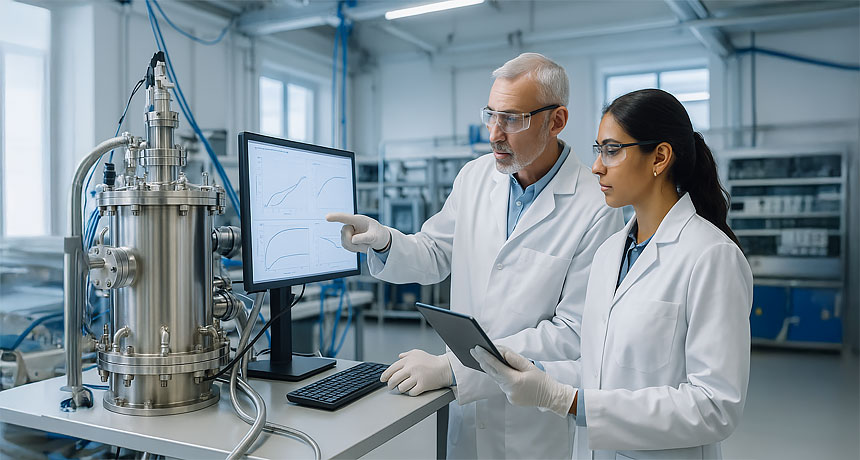
How Superconducting Materials Are Affecting Vacuum Applications
Superconductors used to belong mostly to the realm of fundamental physics. Today, they’re at the heart of real-world systems: particle accelerators, MRI and NMR machines, fusion prototypes, high-field magnets, and rapidly growing quantum computing platforms. As these technologies move from one-off experiments to complex facilities and commercial products, they bring new expectations and challenges for vacuum systems.
Wherever superconducting materials are cooled to cryogenic temperatures, vacuum plays a dual role: it protects ultra-clean surfaces from contamination, and it provides thermal insulation so those surfaces can stay cold enough to remain superconducting. That combination is changing how engineers think about vacuum hardware, pumping strategies, and cleanliness standards.
This article looks at how superconducting materials intersect with vacuum technology, what that means for system design, and how suppliers like High Vac Depot help bridge the gap between theory and reliable day-to-day operation.
Why Superconductors and Vacuum Are So Tightly Linked
Superconductivity is highly sensitive to temperature, magnetic field, and material purity. To maintain zero electrical resistance and stable performance, superconducting components are typically:
- Operated at cryogenic temperatures (liquid helium, liquid nitrogen, or cryocoolers).
- Isolated from contaminants like water vapor, hydrocarbons, and oxygen.
- Shielded from thermal radiation and convective heat loads.
Vacuum supports all three of these needs:
- Thermal insulation – High or ultra-high vacuum (UHV) drastically reduces convective heat transfer, helping cold stages stay cold with manageable cooling power.
- Surface cleanliness – Low pressures minimize adsorption layers and prevent oxidation or contamination of critical superconducting surfaces.
- Process control – Many superconducting devices (such as thin-film coatings for RF cavities or Josephson junctions) are fabricated in vacuum-based deposition and etching systems.
As superconducting applications expand, they drive demand for more sophisticated vacuum environments—both during fabrication and during operation.
Applications Where Superconductors Drive Vacuum Requirements
Particle Accelerators and SRF Cavities
Large research accelerators and some emerging medical and industrial linacs use superconducting radio-frequency (SRF) cavities, often made from high-purity niobium. These cavities demand:
- Pressures in the 10⁻⁹ mbar (10⁻⁹ torr) range or better inside the beamline.
- Extremely low hydrogen and water vapor levels.
- Bakeout and conditioning cycles to reduce outgassing.
Even trace contamination can degrade the quality factor (Q) of the cavity or trigger field emission. That pushes vacuum design toward all-metal seals, UHV-compatible materials, and carefully selected pumps—typically combinations of turbomolecular pumps, ion pumps, and non-evaporable getter (NEG) pumps.
MRI, NMR, and High-Field Magnets
Superconducting magnets for MRI, NMR, and research facilities are usually housed in cryostats where vacuum provides thermal insulation. As newer magnet designs move toward:
- Helium-free or helium-reduced systems, and
- High-temperature superconductors (HTS) cooled by cryocoolers,
the vacuum environment around cold heads and cold masses becomes even more critical. Reliable, low-leak-rate vacuum spaces help minimize cryogen loss and reduce power consumption for cryocoolers.
Quantum Computing and Cryogenic Electronics
Quantum computers rely on superconducting qubits operating at millikelvin temperatures inside dilution refrigerators. These systems typically include:
- Multiple vacuum stages from rough vacuum down into high and ultra-high vacuum.
- Strict limitations on magnetic and particulate contamination.
- Very low outgassing materials for wiring, supports, and filters.
Here, vacuum performance directly affects qubit coherence times and overall system stability. Design engineers turn to oil-free pumps, clean dry forelines, and carefully conditioned chambers to keep backgrounds low.
Fusion Experiments and Advanced Energy Devices
Prototype fusion devices and high-field research magnets use superconducting coils to create strong, stable magnetic fields. Their vacuum systems must:
- Handle large volumes and complex geometries.
- Support both plasma vacuum and cryostat vacuum regions.
- Resist neutron activation and stay serviceable over long lifetimes.
The combination of large-scale superconductors and high-vacuum infrastructure is pushing innovation in robust, radiation-resistant pumps and gauges.
How Superconductors Influence Vacuum Hardware Choices
As superconducting applications spread, they shape hardware decisions in several ways.
Preference for Oil-Free Pumping
Oil backstreaming or even trace hydrocarbon contamination is unacceptable on:
- SRF cavity surfaces
- Superconducting magnet windings
- Thin-film superconducting layers and junctions
As a result, systems increasingly rely on:
- Dry scroll, diaphragm, or screw pumps for roughing and backing.
- Turbomolecular pumps with dry backing for clean high vacuum.
- Cryopumps, ion pumps, and NEG pumps for UHV and hydrogen pumping.
High Vac Depot’s catalog of dry pumps and UHV-compatible components aligns well with these requirements, allowing designers to avoid oil entirely in critical vacuum spaces.
Materials, Seals, and Outgassing
Superconducting devices are often baked and cycled through extreme temperatures. That places strict demands on:
- Sealing technology – all-metal seals (CF flanges) or specially rated elastomers must handle both UHV and cryogenic cycling.
- Construction materials – stainless steels, high-purity copper, niobium, and low-outgassing polymers where absolutely necessary.
- Cleaning and preparation – rigorous cleaning, electropolishing, and vacuum firing procedures reduce outgassing and trapped gases.
Vacuum components—valves, fittings, gauges—must be consistent with these processes and temperature ranges.
Cryopumping Effects
Cold surfaces inside cryostats and dilution refrigerators act as natural cryopumps, trapping gases like water, nitrogen, and oxygen. While this can help reach low pressures, it also creates challenges:
- Over time, trapped gases can build up and desorb during warm-up, leading to pressure spikes.
- Hydrogen and helium are less effectively trapped and may require dedicated pumping.
- Instrumentation must distinguish between a genuinely clean system and one that looks good only because everything is frozen out.
Designers use a combination of room-temperature pumping, bakeouts, and controlled cooldown/warmup procedures to manage these effects.
Design Considerations for Vacuum Systems Around Superconductors
To support superconducting materials effectively, vacuum systems typically incorporate:
- Multiple pressure regimes, from roughing lines to UHV beamlines or qubit cavities.
- Redundant pumping, so that critical regions remain pumped even if one subsystem is offline.
- Careful conductance management, balancing line diameters, valve placement, and pump locations so the coldest and cleanest regions see the best vacuum.
- Thoughtful instrumentation, with gauge types selected for appropriate pressure ranges and compatible with cryogenic operation where necessary.
System designers also pay particular attention to leak tightness. Even small helium leaks are problematic in helium-cooled superconducting systems, both for cost reasons and because helium is notoriously difficult to pump once it gets into unwanted spaces. Helium leak detectors, good practice in all vacuum work, are absolutely essential around superconductors.
Maintenance, Upgrades, and Lifecycle Impacts
Superconducting installations are capital-intensive and expected to operate for many years. That makes vacuum reliability and serviceability a major concern:
- Pump maintenance schedules must be coordinated with cooldown and warmup cycles to avoid costly downtime.
- Component standardization (flanges, fittings, valves) simplifies spare parts management.
- Monitoring and diagnostics—pressure logs, leak histories, and pump performance trends—help predict issues before they threaten operation.
As new superconducting materials (including higher-temperature ceramics and tapes) move into production, many existing vacuum systems are being upgraded. Often the upgrades focus on:
- Replacing oil-sealed pumps with dry technology.
- Adding more sophisticated gauge suites.
- Improving cleanliness standards and bakeout capability.
Future Trends: How New Superconductors May Change Vacuum Further
The development of high-temperature superconductors (HTS) and ongoing research into room-temperature superconductivity (still experimental) could reshape vacuum requirements in the long term.
Some likely trends include:
- Higher operating temperatures reducing cryogenic load, but still requiring good vacuum for insulation and cleanliness.
- More compact cryocooler-based systems in quantum computing, medical devices, and industrial tools, each with integrated vacuum/cryogenic modules.
- Increased demand for modular vacuum components that are easy to integrate into turnkey superconducting platforms.
- Continued emphasis on oil-free, low-maintenance pumps and valves that support remote or automated operation.
Even if superconducting materials become easier to cool, they will remain sensitive to contaminants and surface conditions—so vacuum engineering will continue to be central.
Conclusion
Superconducting materials are reshaping the landscape of high-tech equipment—from accelerators and MRI systems to quantum computers and advanced energy devices. In every case, vacuum technology is a critical enabler, providing the clean, thermally insulated environments that superconductors need to perform reliably.
These applications drive vacuum systems toward oil-free pumping, UHV-compatible materials, cryogenic integration, and smarter instrumentation. They also raise the stakes for leak tightness, outgassing control, and long-term reliability.
If you’re designing, upgrading, or troubleshooting a vacuum system that involves superconducting materials, the team at High Vac Depot is ready to help. From dry roughing pumps and turbomolecular systems to UHV hardware, gauges, and leak detection solutions, our experts can recommend components and strategies tailored to your application. Contact us today to discuss your project and ensure your vacuum infrastructure is ready for the next generation of superconducting technology.



Leave a Reply
You must be logged in to post a comment.