
PLEASE NOTE: Due to global tariffs, prices may fluctuate. To better serve you, we reserve the right to add a surcharge to orders.

Maintenance

Why Calibration Matters for Vacuum Sensors

Vacuum sensors are often treated like small accessories in a larger vacuum system, but they have an outsized influence on how that system is operated. A pump may be healthy, a chamber may be clean, and the plumbing may be leak-tight, but if the sensor is drifting or reading outside its useful range, the operator can still make the wrong decision. In vacuum work, pressure readings are not just numbers on a display. They guide pump-down decisions, process timing, leak...
Read more...

The Role of Backstreaming in Vacuum Contamination

In vacuum work, contamination problems are often blamed on the obvious suspects: leaks, dirty parts, bad materials, or poor cleaning. Those are all real causes. But one contamination source is easy to underestimate because it can come from inside an otherwise functional pumping system: backstreaming.
Read more...

How to Design a Leak-Free Vacuum System

“Leak-free” in vacuum engineering usually means two things: (1) no real leaks to atmosphere (or between isolated volumes), and (2) no hidden gas sources inside the system that behave like leaks (virtual leaks, permeation, outgassing, backstreaming, and trapped volumes). Most vacuum “leak problems” are actually a mix of design choices, assembly practice, and material behavior—so the best time to solve them is at the design stage, not after the system is built. This guide walks through a practical, engineering-first approach...
Read more...

Can a Vacuum Pump Be Too Powerful for an Application?

A vacuum pump can absolutely be “too powerful”—not because it pulls too much vacuum (vacuum is bounded by physics and leaks), but because it can pull too much pumping speed and throughput for the system’s conductance, process behavior, and control needs. Oversizing often wastes money, increases operational risk, and can actually make results less stable. The goal is not “the biggest pump,” but the right effective pumping speed at the chamber—and the right level of control over pressure, gas load,...
Read more...

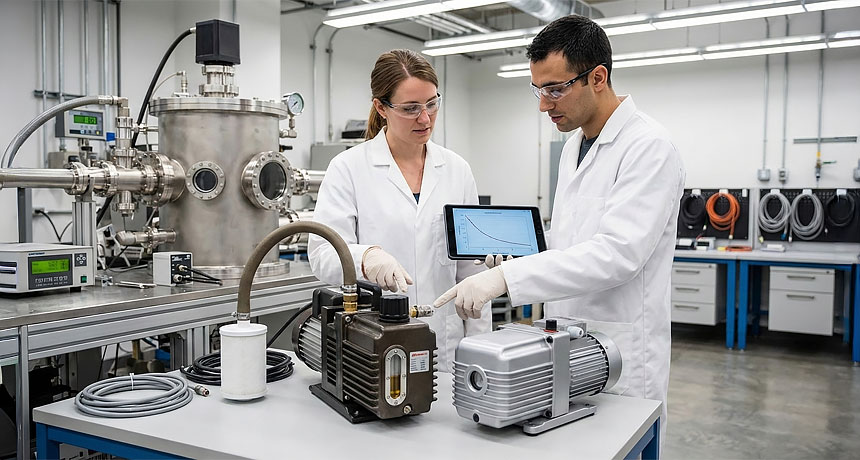
Comparing Oil-Sealed vs Oil-Free Vacuum Pumps

Choosing between an oil-sealed (wet) pump and an oil-free (dry) pump is one of the most consequential decisions in a vacuum system design. It affects everything downstream—base pressure stability, contamination risk, maintenance workload, uptime, and even how forgiving the system is to water vapor and process byproducts. The “right” answer depends on how clean your process must be, how much vapor you expect, what pressure range you need, and what kind of lifecycle cost you can tolerate. This article breaks...
Read more...

How to Minimize Virtual Leaks in Complex Vacuum Systems

Achieving and maintaining high or ultra-high vacuum is rarely limited by pump performance alone. In many advanced systems, especially those with complex geometries, persistent pressure rise and long pump-down times are caused not by real leaks—but by virtual leaks. These hidden gas sources can mimic external leaks, frustrate troubleshooting efforts, and compromise system performance if they are not properly addressed.
Read more...

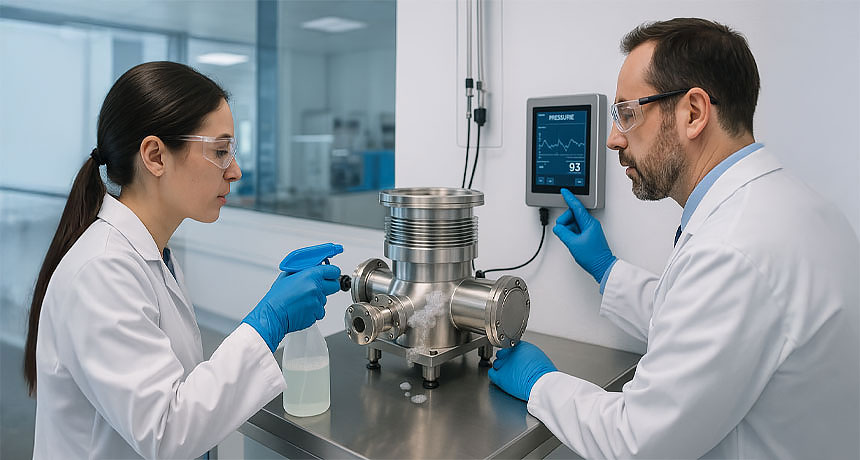
How to Perform a Bubble Leak Test for Low Vacuum Systems

Maintaining leak-tight integrity is one of the most important factors in ensuring reliable vacuum performance. Even small leaks can compromise pressure stability, lengthen pump-down times, and contaminate processes. For high and ultra-high vacuum systems, helium mass-spectrometer leak detection is the gold standard. But when you’re working with low vacuum systems (roughly down to 10⁻³ mbar / 10⁻³ torr), a more practical and cost-effective method often makes more sense: the bubble leak test.
Read more...

Vacuum Pump Rebuild Service: Ensuring Peak Performance for Your Equipment

Vacuum pumps are indispensable in a variety of industries, including pharmaceuticals, semiconductor manufacturing, food processing, and many others. These pumps ensure that processes run smoothly by creating controlled environments, free of air and other gases. Over time, however, even the most robust vacuum pumps can suffer from wear and tear, reducing their efficiency and reliability. This is where a professional vacuum pump rebuild service becomes invaluable.
Read more...

Optimize Your Vacuum System’s Performance with These Proven Suggestions

In the realm of industrial and laboratory applications, the efficiency and reliability of vacuum systems are paramount. Whether it’s in a semiconductor fabrication facility, a research laboratory, or a pharmaceutical manufacturing plant, vacuum systems play a crucial role in various processes. To ensure optimal performance and productivity, it’s essential to implement proven strategies and techniques. In this article, we’ll explore some key suggestions to optimize your vacuum system’s performance.
Read more...

Common Leak Checking Configurations

In industries that rely on vacuum technology, ensuring leak-tight systems is of paramount importance. A leak in a vacuum system can compromise efficiency, accuracy, and safety. To mitigate such issues, various leak checking configurations and procedures have been developed to guarantee the integrity of these systems. In this article, we will delve into common leak checking configurations used in vacuum technology and discuss their significance in maintaining reliable vacuum systems.
Read more...

"*" indicates required fields

This field is for validation purposes and should be left unchanged.
I would like to request a quote for the following product:
Anything else we need to know? Make, model, or other details.
Name*
Shipping Address*
A shipping address is required to receive a quote so we can more easily provide you with the best price possible.