


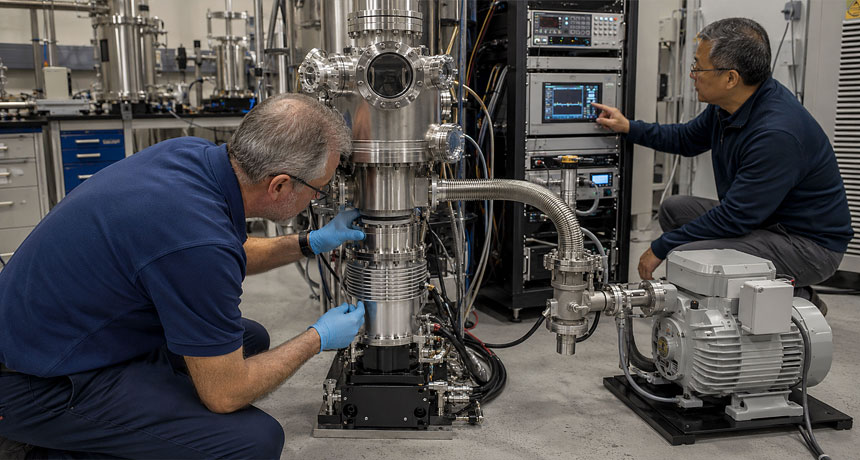
Understanding Molecular Drag Pumps and Their Applications
Molecular drag pumps occupy an interesting place in vacuum technology. The basic principle dates back more than a century, yet it remains highly relevant in modern high-vacuum equipment. In fact, many users benefit from molecular drag pumping without realizing it because the technology is frequently integrated into compound turbomolecular pumps rather than used as a completely separate pump.
At its core, a molecular drag pump moves gas by transferring momentum from a rapidly moving surface to gas molecules. This approach becomes effective as pressure falls and gas behavior shifts away from ordinary viscous flow. Modern drag stages are especially useful because they can increase compression and allow a turbomolecular pump to tolerate higher pressure on its exhaust side. That can make the overall vacuum system smaller, cleaner, and easier to integrate.
Understanding how molecular drag technology works helps explain why modern turbo pumps can operate with compact backing pumps, achieve strong compression ratios, and fit into analytical instruments, research systems, coating equipment, and other applications where space and vacuum performance both matter.
How molecular drag pumping works
At atmospheric pressure, gas behaves much like a continuous fluid because molecules collide with one another constantly. As pressure decreases, those intermolecular collisions become less frequent. Eventually, gas molecules interact with chamber and pump surfaces more often than they collide with each other.
This molecular-flow environment makes momentum-transfer pumping possible.
A molecular drag pump places a rapidly moving rotor surface very close to a stationary surface. Gas molecules that interact with the moving surface receive momentum in the direction of rotation. Internal channels guide those molecules toward the exhaust side of the pump while restricting their movement back toward the inlet.
The effect is repeated through a long pumping path, gradually compressing the gas.
This principle differs from a conventional positive-displacement pump. A rotary vane or scroll pump creates changing physical volumes that trap and compress gas. A molecular drag pump does not operate that way. Instead, it relies on the interaction between individual gas molecules and high-speed moving surfaces.
That difference is why molecular drag pumps need reduced pressure before they can operate effectively.
Gaede, Holweck, and Siegbahn designs
Several molecular drag concepts have been developed over the history of vacuum technology.
The early Gaede molecular pump used closely spaced rotating and stationary surfaces to impart directional momentum to gas molecules. The basic idea established the principle of using a moving surface to transport gas under molecular-flow conditions.
The Holweck design refined that idea into a geometry that remains important today. In a typical Holweck stage, a cylindrical rotor operates inside a stator containing helical pumping channels, although the arrangement can also be reversed. As the rotor turns, molecules are driven along those spiral channels toward the forevacuum side.
The Siegbahn concept uses spiral channels associated with disk-like geometry instead of the long cylindrical configuration of the traditional Holweck design.
Modern vacuum users rarely need to choose among these historical configurations directly. What matters is that the same physical concepts remain inside current high-performance pumps. A good example is the Edwards nEXT 240 turbo pump, which is part of a compound turbomolecular pump family that incorporates molecular drag technology to improve compression and operating flexibility.
Why drag stages are combined with turbomolecular pumps
A conventional turbomolecular pump uses alternating high-speed rotor blades and stationary stator blades. The rotor transfers momentum to gas molecules, progressively directing them from the high-vacuum inlet toward the foreline.
This works extremely well under molecular-flow conditions, but the lower stages of the pump face increasingly higher gas density as molecules are compressed toward the outlet.
Adding a molecular drag section below the turbomolecular stages helps bridge that gap.
The bladed turbo section handles the high-vacuum side efficiently. The drag section then provides additional compression closer to the exhaust, where pressure is higher. Because of this combination, compound turbo-drag pumps can often tolerate higher foreline pressures than a traditional pure turbomolecular design.
That has an important system-level benefit: the backing pump may not need to reach as low a pressure or provide as much capacity as it would with another turbo design.
High Vac Depot’s guide to choosing the right roughing pump discusses why the relationship between the high-vacuum pump and backing pump matters. Neither component should be selected in isolation.
Molecular drag does not eliminate the backing pump
One misconception worth clearing up is that a molecular drag stage allows a turbo pump to exhaust directly to atmosphere. It does not.
The turbo-drag pump still requires a backing or roughing pump to evacuate the foreline and ultimately discharge gas to atmosphere. The drag stage simply improves the pressure conditions the high-vacuum pump can tolerate at its outlet.
Depending on the application, that backing pump might be an oil-free dry scroll pump or an oil-sealed rotary vane pump.
Dry scroll pumps are attractive for contamination-sensitive research and analytical equipment because the process-facing pumping mechanism does not rely on oil. Rotary vane pumps remain useful where strong roughing performance, compact size, and cost effectiveness are priorities.
The correct pairing depends on gas load, target pressure, pump size, process chemistry, cleanliness requirements, and acceptable foreline pressure.
Higher compression in a compact package
One reason molecular drag stages remain important is that they provide substantial compression without requiring a completely separate high-vacuum pump.
This is particularly valuable for light gases. Hydrogen and helium are generally more difficult for turbomolecular systems to compress than heavier gases such as nitrogen because their higher molecular velocities make backflow more likely. Pump designers use blade geometry, rotational speed, multiple stages, and drag sections to improve light-gas compression.
The resulting pump can offer a useful balance between pumping speed at the inlet and strong compression closer to the exhaust.
It is important, however, not to confuse compression ratio with pumping speed. A molecular drag stage does not automatically make the inlet pumping speed dramatically higher. Its main contribution is often improved compression and foreline tolerance.
High Vac Depot’s discussion of the relationship between vacuum level and pumping speed helps explain why these specifications should be considered separately when comparing pumps.
Applications in analytical instrumentation
Analytical equipment is one of the most natural applications for compound turbo-drag pumping.
Mass spectrometers, gas-analysis systems, electron microscopes, surface-analysis instruments, and similar tools often need high vacuum but have limited internal space. They may also need quiet, clean operation and relatively compact backing pumps.
A turbo pump with an integrated drag stage can fit that combination well. The high-vacuum stage provides the pressure required by the instrument, while the drag section improves compression and makes the forevacuum requirements easier to manage.
Modern turbo controllers also make these pumps easier to integrate into OEM instruments. Controllers can monitor speed, temperature, current, operating status, and faults while communicating with the larger instrument control system.
For laboratory setups where an integrated solution is preferred, turbo pump stations combine much of the required pumping hardware into a more complete system.
Thin-film, coating, and semiconductor applications
Thin-film deposition and semiconductor processes also benefit from compound turbo pumping.
These applications frequently require clean high vacuum while processing controlled gas loads. A turbo-drag design can offer good high-vacuum pumping while improving gas throughput and foreline-pressure tolerance compared with a simpler turbo configuration.
System cleanliness is particularly important in these environments. Pairing the high-vacuum pump with an oil-free backing pump can reduce the risk of hydrocarbon contamination from the foreline.
Pressure measurement must also cover multiple operating regimes. A deposition system may move from rough vacuum through crossover and into high vacuum before process gases are introduced. The proper vacuum gauges allow operators or control systems to understand what is happening throughout that sequence rather than relying on one sensor outside its useful range.
Research and general high-vacuum systems
Molecular drag stages also appear in vacuum equipment used for university research, materials science, accelerator support, detector systems, vacuum furnaces, cryogenic experiments, and general R&D.
In these applications, the main attraction is often flexibility. A compound turbo pump can deliver high-vacuum performance without requiring an oversized forevacuum system.
Compactness becomes especially valuable on mobile systems, crowded research benches, instruments mounted inside enclosures, and facilities where pump noise, heat, and utility requirements need to be minimized.
Complete turbo packages can simplify selection by matching pumps with appropriate controllers and supporting equipment rather than requiring every element to be sourced independently.
System design still determines actual performance
Adding a drag stage does not remove the normal rules of vacuum engineering.
Conductance remains critical. If a high-performance pump is connected to the chamber through a long, narrow tube, restrictive valve, or undersized fitting, the chamber will never see the full rated pumping speed.
The pump should generally be positioned as close to the chamber as practical, using adequately sized vacuum hardware. Larger turbomolecular pumps commonly use ISO flanges and fittings because they can provide large conductance paths while remaining serviceable.
Gas load also matters. A pump designed for a small analytical chamber may not perform appropriately on a large vessel with continuous process flow. Likewise, a pump optimized for strong light-gas compression may have different priorities than one designed for maximum throughput of heavier process gases.
Cooling, mounting orientation, bearing design, venting, controller setup, and backing pressure all need to stay within the manufacturer’s requirements.
When a turbo-drag pump may not be the right answer
Molecular drag technology is useful, but it does not make a turbo pump suitable for every vacuum application.
A turbo-drag pump is not a substitute for a roughing pump when evacuating a large chamber from atmosphere. Processes that produce heavy particulate loads, large quantities of condensable vapor, or aggressive chemical byproducts may require additional protection or a different pumping technology.
Very high gas-throughput applications may also be better served by a vacuum architecture built around larger dry pumps, boosters, or specialized process pumps rather than expecting the high-vacuum pump to handle the entire load.
The right decision comes from looking at the complete operating envelope: chamber volume, target pressure, pump-down time, gas species, throughput, cleanliness requirements, foreline conditions, duty cycle, and maintenance expectations.
If an existing system has unexpectedly long pump-down times or poor base pressure, High Vac Depot’s guide to troubleshooting common vacuum issues can help determine whether the problem is the pump, backing system, conductance, contamination, leakage, or another part of the vacuum train.
Conclusion
Molecular drag pumps work by transferring momentum from rapidly moving surfaces to individual gas molecules and directing those molecules through narrow pumping channels toward the exhaust. While standalone molecular drag pumps are less common in modern general-purpose vacuum systems, the technology remains highly relevant through the drag stages incorporated into many compound turbomolecular pumps.
Those stages can improve compression, increase foreline-pressure tolerance, support compact backing-pump arrangements, and make high-vacuum systems easier to integrate into analytical instruments, coating tools, research systems, and industrial equipment.
The key is to evaluate the entire pumping system rather than focusing on one technology in isolation. Turbo design, drag-stage performance, backing pump capability, conductance, gauges, controls, gas load, and application requirements all work together.
If you need help selecting a turbo pump, matching a backing pump, comparing turbo-drag configurations, or troubleshooting a high-vacuum system, contact the experts at High Vac Depot. The team can help you evaluate the pumps, controllers, gauges, hardware, and system requirements needed to build a vacuum solution that performs reliably in your application.






Leave a Reply
You must be logged in to post a comment.