


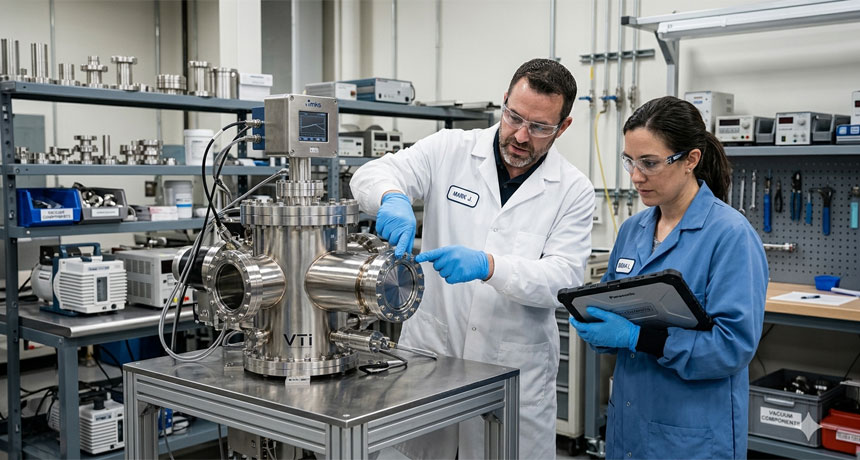
Why Stainless Steel is the Gold Standard for Vacuum Chambers
In vacuum engineering, material choice is never a cosmetic decision. The chamber wall is part of the vacuum system itself: it influences outgassing, leak integrity, chemical compatibility, mechanical stability, cleaning, and long-term reliability. While aluminum, glass, and specialty alloys all have their place, stainless steel has earned its reputation as the gold standard for vacuum chambers because it delivers the best all-around balance of cleanliness, strength, fabricability, and compatibility across a wide range of vacuum regimes.
That reputation is not based on habit or tradition alone. Stainless steel performs well where vacuum systems are most demanding: under repeated pumpdown cycles, bakeout conditions, mechanical loading, and exposure to real-world process gases. It also integrates naturally with the fittings, flanges, valves, and instrumentation that make up a practical chamber system.
Stainless steel performs well across a wide range of vacuum applications
One of the biggest reasons stainless steel remains the default choice is versatility. A single stainless chamber platform can serve in rough vacuum, high vacuum, and many ultra-high-vacuum-adjacent applications when the rest of the system is designed correctly. That flexibility matters for labs and facilities that expect systems to evolve over time.
When a chamber is built from stainless steel, it pairs naturally with common hardware and fittings, including both modular and metal-sealed connection styles. For example, many systems transition between KF flanges and fittings for serviceable plumbing and CF flanges and fittings where tighter, more bakeable seals are required. That compatibility is one reason stainless steel remains such a practical chamber material in the field.
Low outgassing and better vacuum cleanliness
Vacuum systems are never truly empty. Every internal surface contributes some gas load, whether through adsorbed water vapor, hydrocarbons, trapped contaminants, or slow material desorption. A major advantage of stainless steel is that, when properly finished and cleaned, it offers relatively predictable and manageable outgassing behavior compared with many alternative materials.
That does not mean stainless steel is magically gas-free. High Vac Depot’s own discussion of outgassing in vacuum systems notes that even stainless steel contributes gases at high vacuum, particularly carbon monoxide and hydrogen, but it remains far more suitable than many porous, organic, or elastomer-heavy alternatives. The practical takeaway is that stainless steel gives engineers a controllable baseline. With proper cleaning, handling, and bakeout, it supports cleaner and more repeatable vacuum performance.
This becomes especially important in analytical systems, thin-film work, research chambers, and process tools where contamination control matters as much as pressure level.
Mechanical strength and dimensional stability
A vacuum chamber is a pressure vessel under external load. At atmosphere, the walls, ports, welds, and flanges all experience significant mechanical stress. Stainless steel is well suited to this because it combines strength with ductility, allowing chambers to resist deformation without becoming excessively brittle.
That strength matters for more than safety. It also supports better dimensional stability over time. A stainless chamber is less likely to warp, distort, or suffer sealing inconsistency under repeated use than softer alternatives in similar service. This is especially valuable when you are mounting multiple ports, attaching instrumentation, or integrating valves and viewports in ways that place real mechanical demands on the chamber body.
It also supports better sealing consistency at flange faces. If the mating surfaces stay true, leak-tight joints are easier to achieve and maintain.
Excellent compatibility with vacuum flange systems
Another reason stainless steel dominates vacuum chamber construction is that the broader vacuum hardware ecosystem is built around it. Many of the most widely used chamber interfaces, adapters, blanks, elbows, and welded connections are available in 304 or 316 stainless, which simplifies design and reduces material mismatch.
For high-vacuum and UHV-style chamber interfaces, CF hardware is especially important. High Vac Depot’s article on proper torquing of CF flanges highlights how ConFlat seals rely on a metal-to-metal sealing concept with OFHC copper gaskets and stainless flange bodies. That combination is one reason stainless chambers are so common where leak integrity and bakeability matter.
Stainless steel also works well with broader ISO flange components and welded plumbing elements such as stainless elbows and tube sections. In practical terms, that means engineers can build complete systems around one material family rather than constantly bridging dissimilar metals.
Corrosion resistance and process durability
Vacuum chambers do not live in idealized conditions. They get vented, cleaned, exposed to fingerprints, process vapors, humid air, pump oils, and sometimes aggressive gases. Stainless steel’s corrosion resistance is a major reason it remains preferred in both laboratory and industrial systems.
Grades such as 304 and 316 stainless are widely used because they balance corrosion resistance, fabrication ease, and availability. On High Vac Depot’s fabrication page, stainless steel 304 and stainless steel 316 are explicitly offered as chamber and component materials for custom work. That reflects real-world demand: engineers trust stainless because it holds up well in service and remains easier to clean back to an acceptable surface condition after maintenance or contamination events.
While no material is universally immune to every chemistry, stainless steel handles the day-to-day realities of vacuum use better than many alternatives.
Better fabrication and customization potential
A vacuum chamber is rarely just a box. It needs ports, bosses, mounting points, gauge connections, valve interfaces, feedthroughs, and sometimes custom internal geometry. Stainless steel is an excellent fabrication material because it can be machined, formed, and welded into complex chamber designs without sacrificing overall integrity.
This is where stainless steel really separates itself from materials that may look attractive on paper but are more limited in custom fabrication. If you need custom chambers, unusual port layouts, or application-specific geometry, High Vac Depot’s custom fabrication service is built around exactly those kinds of vacuum components and offers stainless as a standard material choice.
That flexibility matters because chamber design is often driven by the process, not the other way around.
Stainless steel supports better sealing discipline
Vacuum performance depends heavily on seal quality, and seal quality depends heavily on the surfaces surrounding the seal. Stainless steel offers a stable, machinable sealing surface that works well with both elastomer-based and metal-gasket designs.
For example, systems using modular clamps and O-rings benefit from well-machined stainless sealing faces that resist damage and clean up predictably. Metal-sealed systems benefit even more, because knife-edge geometry, bolt loading, and gasket compression all rely on the flange maintaining dimensional integrity.
Hardware also matters. Stainless-compatible fasteners, nuts, and specialty hardware are widely available through High Vac Depot’s CF hardware selection, and details such as silver-plated hardware can improve assembly reliability in demanding vacuum applications. The broader point is simple: stainless steel is not just good chamber material by itself; it fits into a mature sealing ecosystem that supports dependable leak-tight assembly.
It works well with instrumentation and process control components
Chambers do not operate alone. They depend on gauges, valves, fittings, and process control hardware. Stainless steel integrates cleanly with those systems, which is one reason it remains the preferred foundation for serious vacuum builds.
If you are installing measurement hardware, High Vac Depot’s guidance on vacuum pressure transducers emphasizes clean installation practices and compatible materials such as stainless steel to avoid outgassing or unwanted reactions. The same logic applies to chamber-adjacent components like vacuum valves, many of which are also offered in stainless construction for durability and process compatibility.
Using stainless as the chamber base simplifies those integration decisions.
Are there cases where something else makes sense?
Yes. Aluminum can make sense where weight, machining speed, or cost matters more than long-term bakeability or robustness. Glass is valuable when visual access is the priority. Specialty alloys or ceramics may be necessary in extreme thermal or chemical environments.
But those are usually application-specific exceptions. When engineers need a chamber material that performs reliably across a broad range of pressures, temperatures, fabrication styles, and operating conditions, stainless steel remains the safest and most proven default.
That is why it is so often the starting point for serious chamber design.
Conclusion
Stainless steel is the gold standard for vacuum chambers because it solves more vacuum engineering problems than it creates. It offers low and manageable outgassing, strong mechanical performance, good corrosion resistance, excellent flange compatibility, solid weldability, and dependable sealing surfaces. Just as important, it fits naturally into the broader ecosystem of vacuum hardware, valves, gauges, and custom fabrication options that real systems depend on. If you are planning a new chamber or upgrading an existing system and want help selecting the right material, fittings, and chamber configuration, contact the experts at High Vac Depot through their consulting services or the main contact page. They can help you build a chamber solution that performs reliably in the real world.






Leave a Reply
You must be logged in to post a comment.