



Understanding Ion Implantation in Vacuum Environments: A Deep Dive
In the world of modern technology and material science, the process of ion implantation stands out as a revolutionary method used in semiconductor manufacturing, metallurgy, and advanced research fields. Ion implantation involves bombarding a target material with high-energy ions to modify its physical, chemical, or electrical properties. This intricate process cannot be efficiently carried out without a precisely controlled vacuum environment. Here’s an in-depth look at how ion implantation works, why a high-quality vacuum is crucial, and how advancements in vacuum technology are paving the way for further innovation.
The Basics of Ion Implantation
Ion implantation is a technique primarily used in semiconductor manufacturing to alter the properties of materials like silicon wafers. The process begins by generating ions from a source material. These ions are then accelerated using an electric field, reaching kinetic energies high enough to penetrate the target material. When these ions strike the material’s surface, they embed themselves into the lattice structure, causing changes in electrical conductivity, structural integrity, or other desired attributes.
Applications Across Various Industries
While ion implantation is heavily associated with the semiconductor industry, it also finds applications in areas like:
- Optics: Creating anti-reflective surfaces or modifying optical properties of lenses and glass.
- Medical Device Manufacturing: Enhancing the biocompatibility and wear resistance of medical implants.
- Metallurgy: Improving corrosion resistance and hardness of metals.
- Materials Research: Tailoring material properties for aerospace or defense applications.
Why Vacuum Environments Are Essential
A key component of ion implantation technology is the use of a vacuum chamber. But why is a vacuum so critical in this process?
Preventing Contamination
In an atmospheric environment, air molecules and impurities could interfere with the ion beam, causing unwanted scattering and reducing the precision of ion implantation. A high-quality vacuum environment ensures that ions travel unimpeded to their target, maintaining accuracy and preventing contamination of the target material.
Controlling Ion Energy
A vacuum environment provides a controlled setting where the energy and trajectory of the ions can be precisely adjusted. This control is crucial for achieving uniform implantation depths and maintaining consistency across the treated material. In the semiconductor industry, where even minor imperfections can compromise an entire batch of chips, this level of precision is non-negotiable.
The Role of Advanced Vacuum Technology
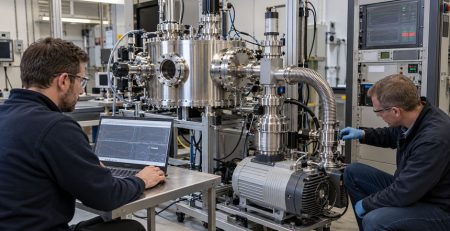
Maintaining a vacuum environment for ion implantation requires sophisticated equipment, notably turbomolecular vacuum pumps and cryogenic pumps. These pumps are essential for achieving and sustaining the ultra-high vacuum (UHV) levels required for ion implantation. Let’s take a closer look at how these pumps work and why they are indispensable.
Turbomolecular Vacuum Pumps
Turbomolecular pumps are commonly used to achieve UHV conditions in ion implantation systems. They work by using a rapidly rotating turbine to transfer momentum to gas molecules, effectively pushing them out of the chamber. The efficiency and speed of these pumps make them ideal for applications that demand high levels of vacuum.
- Key Features: Turbomolecular pumps offer rapid pump-down times and are highly effective in removing both light and heavy gases.
- Benefits: Their efficiency allows for stable and reproducible vacuum conditions, which are essential for consistent ion implantation results.
Cryogenic Pumps
Cryogenic pumps, on the other hand, use extremely low temperatures to condense and trap gas molecules. They are often used in tandem with turbomolecular pumps to maintain a high-vacuum environment over extended periods. Cryopumps are especially useful for removing water vapor and other gases that are difficult to eliminate using mechanical pumps alone.
Challenges in Ion Implantation and How Vacuum Technology Overcomes Them
Even with advanced vacuum technology, ion implantation comes with its set of challenges:
- Maintaining UHV Levels: The process of ion implantation can generate gas molecules from the target material or from interactions within the chamber. Turbomolecular and cryogenic pumps must continuously work to maintain UHV conditions.
- Material Outgassing: Some materials may release gases when exposed to the vacuum environment, complicating the implantation process. High-quality vacuum systems are designed to minimize these effects.
- Beam Stability: Variations in vacuum pressure can affect the stability of the ion beam. Modern vacuum technology provides the consistency needed to avoid these fluctuations, ensuring accurate implantation.
Innovations in Vacuum Technology for Ion Implantation
Research and development in vacuum technology are continually improving the efficiency and precision of ion implantation. For example, advancements in sensor technology allow for real-time monitoring of vacuum conditions, ensuring that any deviations are immediately corrected. Additionally, new materials used in the construction of vacuum chambers and pumps have enhanced the longevity and reliability of vacuum systems.
The integration of smart technologies, such as IoT-enabled vacuum systems, is also revolutionizing the industry. These systems can automatically adjust vacuum levels, predict maintenance needs, and provide detailed analytics, making the ion implantation process more efficient than ever before.
Conclusion: Partnering with Experts for Optimal Solutions
Ion implantation in vacuum environments is a sophisticated process that relies heavily on advanced vacuum technology. From preventing contamination to ensuring precise control over ion energy, a well-maintained vacuum system is vital for success. At High Vac Depot, we specialize in providing state-of-the-art vacuum solutions tailored to your specific needs. Our team of experts is here to guide you through the complexities of vacuum technology and ensure that your operations run smoothly and efficiently.
Have questions or need more information? Contact High Vac Depot today and let our experienced professionals assist you with all your vacuum technology requirements.





Leave a Reply
You must be logged in to post a comment.