


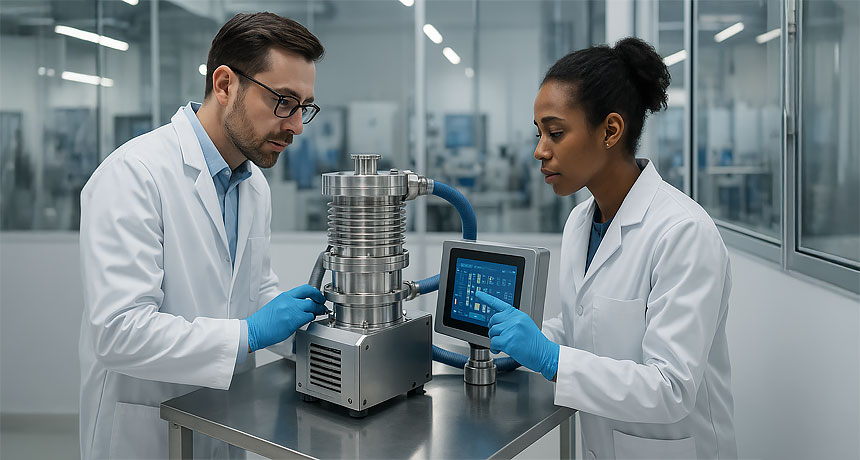
The Future of Vacuum Pumps: Where the Industry Is Heading
As we move further into 2025 and beyond, vacuum technology is experiencing a profound transformation driven by trends in sustainability, digitalization, miniaturization, and new market demands. Whether it’s in semiconductor fabs, pharmaceutical production, aerospace, or clean energy, the next generation of vacuum pumps isn’t just about pressure—it’s about intelligence, efficiency, versatility, and resilience. In this article, we’ll explore the major developments shaping the future of vacuum pumps and what they mean for users and system designers.
Rugged Market Growth & Driving Forces
The global vacuum pump industry is projected to expand significantly in the coming decade. Market outlooks point to steady growth driven by semiconductor demand, electrification, advanced materials, and biopharma scale-up. Adoption is rising across automotive, electronics, pharmaceuticals, energy, food processing, and more, with Asia-Pacific representing a large portion of new capacity. The surge is being fueled by emerging technologies and user-driven needs for cleaner, more efficient vacuum systems.
Oil-Free and Dry Pumps as the New Standard
One of the strongest trends is the shift toward oil-free and dry vacuum pumps. These designs eliminate hydrocarbon backstreaming, simplify compliance in clean environments, and reduce maintenance. Expect dry pumps to become the baseline in labs, cleanrooms, and high-tech manufacturing.
- Cleaner processes: No oil migration to chambers or forelines.
- Lower total cost of ownership: Fewer oil changes, fewer consumables, less downtime.
- Regulatory alignment: Supports food/pharma hygiene and environmental goals.
Smart Integration & Industry 4.0
Vacuum pumps are becoming smarter and more connected. Modern systems incorporate on-board sensors and edge analytics to support predictive maintenance and line optimization.
- IoT connectivity & remote monitoring: Live health status, alarms, and KPIs.
- Digital twins: Model-based diagnostics for uptime and process tuning.
- Variable-speed drives: Match load dynamically, cutting energy use and noise while extending pump life.
These capabilities deliver greater reliability and lower total cost of ownership while enabling deeper integration with MES/SCADA environments.
Compact, Lightweight & Specialized Designs
Footprint and flexibility matter. The latest turbomolecular and dry pumps deliver impressive throughput in smaller, lighter packages suited for tight tools, mobile service carts, and modular production cells.
- Space-efficient layouts: Bench-scale research, pilot skids, and retrofits benefit from compact pumps.
- Advanced materials & manufacturing: High-strength alloys and additive manufacturing enable complex, vacuum-compatible geometries without compromising integrity.
Emerging Technologies & UHV Innovations
Ultra-high vacuum (UHV) demands continue to push the envelope for clean, stable pumping solutions.
- NEG and titanium sublimation modules: Extremely low base pressures with minimal contamination.
- Next-gen cryopumps: Higher capacity and faster regeneration for semiconductor and quantum research tools.
- Improved drag stages: Hybrid turbo designs boost compression at lower power.
Sustainability & Regulatory Influence
Energy and environmental performance are now first-class requirements for many projects.
- Energy efficiency: Variable-speed control, efficient motors, and optimized gas handling reduce kWh per tool.
- Oil-free portfolios: Eliminate oil waste streams and simplify environmental reporting.
- Water stewardship: Cooling strategies and closed-loop options cut water consumption.
Sector-Specific Innovations
- Semiconductors & electronics: Dry pumping stacks, contamination management, and smart monitoring for advanced nodes and specialty deposition/etch.
- Pharma & biotech: Clean, oil-free vacuum for freeze-drying, sterile filtration, and packaging with traceability and audit trails.
- Energy & environment: Vacuum for solar coating, battery manufacturing, biogas, and wastewater aeration with a focus on uptime and low OPEX.
What’s Next for the Vacuum Pump Industry
Looking ahead, expect convergence of digital and mechanical innovation:
- Hybrid systems: Modular pumping trains that reconfigure for different recipes and loads.
- Lifecycle intelligence: From commissioning to decommissioning, asset data will drive service and upgrades.
- Design for sustainability: Recyclable materials, lower embodied carbon, and circular service models.
- Broader adoption of dry-pump designs: Becoming the default across laboratories and fabs.
Conclusion
The future of vacuum pumps is smart, sustainable, and optimized for precision. From IoT-enabled, energy-savvy oil-free platforms to UHV-ready getters and cryo modules, the industry is evolving to meet advanced manufacturing, scientific, and environmental demands.
Whether you’re selecting pumps for semiconductor tools, biotech labs, aerospace test stands, or clean-food processing, understanding these trends helps you invest in reliable, future-ready solutions.
The experts at High Vac Depot track these technologies closely. Contact us today to explore the latest pump platforms, get tailored recommendations, or upgrade your system for greater efficiency, reliability, and sustainability.




Leave a Reply
You must be logged in to post a comment.