


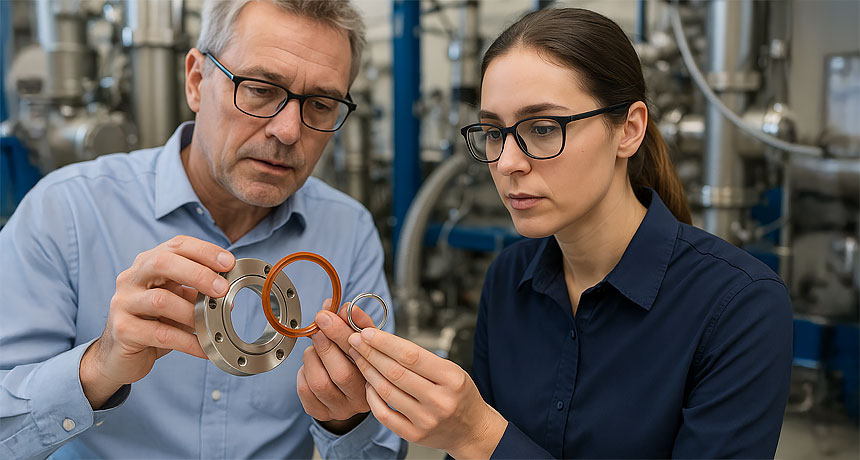
Comparing Ceramic vs Metal Seals for High Vacuum Applications
In the demanding world of high vacuum and ultra-high vacuum (UHV) environments, choosing the right sealing material is critical. Whether you’re working in semiconductor fabrication, space simulation, surface analysis, or high-energy physics, the seals in your vacuum system help define the limits of your performance. Two of the most trusted materials for high vacuum sealing are ceramic and metal—each with distinct advantages, limitations, and ideal use cases.
In this post, we’ll explore how ceramic and metal seals compare in terms of vacuum integrity, thermal performance, chemical resistance, reusability, and more—so you can make an informed decision when designing or upgrading your system.
Why Seal Material Matters
At pressures below 10⁻⁶ mbar, even the smallest gas leak or outgassing event can disrupt experiments, contaminate processes, or damage sensitive equipment. That’s why UHV systems rely on rigid, hermetic, and low-outgassing seals—not the elastomer O-rings commonly used in rough vacuum or industrial systems.
Ceramic and metal seals are chosen for their leak-tightness, durability, and resistance to temperature and chemical degradation, making them well-suited for harsh or mission-critical environments.
Ceramic Seals: Properties and Applications
What Are Ceramic Seals?
Ceramic vacuum seals are typically made from high-purity alumina (Al₂O₃), beryllia, or other advanced ceramics. They’re used in both static seals and electrical feedthroughs, where they serve to electrically isolate components while maintaining vacuum integrity.
Key Properties
- Excellent electrical insulation
- Low outgassing
- High thermal stability
- Strong corrosion resistance
- Brittle but hard
Common Applications
- UHV-compatible electrical feedthroughs
- High-temperature vacuum furnaces
- Particle accelerators
- Plasma and ion beam systems
- Medical sterilization chambers
Pros of Ceramic Seals
- Excellent for high-voltage and high-temperature environments
- Chemically inert
- Stable under extreme heat
- Electrically insulating
Cons of Ceramic Seals
- Brittle and prone to cracking
- Higher cost
- Not usually reusable
- Installation requires care
Metal Seals: Properties and Applications
What Are Metal Seals?
Metal vacuum seals—most often made from annealed copper, aluminum, indium, or nickel alloys—are used with metal flanges (like CF, ISO, or KF) to create static, high-integrity seals.
Key Properties
- Leak-tight to below 10⁻¹² mbar·l/s
- Thermally conductive
- Low outgassing rates
- Bakeable up to 450°C
Common Applications
- High and ultra-high vacuum systems
- Beamline and analytical equipment
- Space simulation chambers
- Scientific research equipment
Pros of Metal Seals
- Outstanding vacuum performance
- Mechanically robust
- Reusable in some configurations
- Lower cost and standard availability
Cons of Metal Seals
- Poor electrical insulation
- May require precise torque for sealing
- Not suitable for every temperature or chemical environment
Ceramic vs Metal Seals: Head-to-Head Comparison
| Property | Ceramic Seals | Metal Seals |
|---|---|---|
| Vacuum Range | High vacuum to UHV | High vacuum to UHV |
| Electrical Insulation | Excellent | Poor |
| Thermal Performance | Excellent | Good |
| Mechanical Strength | Brittle | Ductile |
| Corrosion Resistance | Excellent | Good |
| Reusability | Rare | Possible |
| Installation Complexity | High | Moderate |
| Cost | Higher | Moderate |
When to Choose Ceramic Seals
- When electrical insulation is required
- In high-temperature or chemically aggressive environments
- For stable, fixed UHV designs
When to Choose Metal Seals
- For maximum vacuum tightness and modularity
- In applications requiring frequent maintenance
- When cost or standardization is important
Hybrid Designs and Alternatives
Modern UHV systems often use ceramic and metal seals together in hybrid components, combining the strengths of each. For example, metal-ceramic brazed assemblies allow for electrical feedthroughs with vacuum-tight connections.
Best Practices for Seal Performance
- Always clean components before assembly
- Apply torque according to manufacturer specifications
- Handle ceramics carefully to avoid cracks
- Bake out slowly and evenly
Conclusion
Choosing between ceramic and metal seals for your high vacuum application depends on your system’s specific needs. Ceramic seals are ideal for applications involving electrical isolation, extreme temperatures, or aggressive gases. Metal seals are preferred for their durability, vacuum integrity, and ease of use in modular systems.
If you’re unsure which type of seal is right for your vacuum setup, the experts at High Vac Depot are here to help. We’ll evaluate your system’s requirements and provide a tailored solution that ensures vacuum reliability and operational efficiency. Contact us today to speak with a vacuum specialist!



Leave a Reply
You must be logged in to post a comment.