


The Use of Vacuum in High-Energy Physics Research
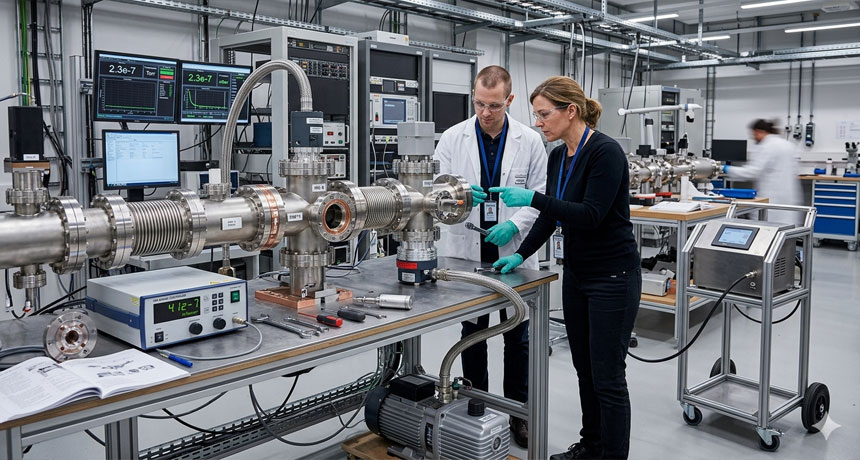
High-energy physics research depends on vacuum for a simple reason: particle beams do not behave well in air. Whether the work involves a large accelerator, an experimental beamline, a detector test stand, or an instrument-development lab, the goal is the same. Researchers need a controlled environment where charged particles can travel long distances, collide where intended, and be measured without unnecessary interference. In practice, that means designing vacuum systems that reduce beam-gas interactions, limit contamination, protect sensitive hardware, and stay stable over long operating cycles.
For vacuum engineers and technical buyers, high-energy physics is a useful example of what happens when vacuum performance is pushed to its practical limits. The systems are large, highly instrumented, and unforgiving of weak design choices. Conductance losses, outgassing, virtual leaks, marginal seals, poor gauge placement, and contaminated surfaces all show up quickly. That is why this field relies on a careful combination of pump selection, chamber materials, metal-sealed connections, leak testing, and disciplined assembly practice.
Why vacuum matters so much in particle physics
At the most basic level, vacuum allows particle beams to travel with minimal interference. Residual gas molecules inside a beam pipe can scatter the beam, reduce beam lifetime, add noise to detector data, and create unwanted background signals. In a machine built to study rare events or measure very small effects, those losses matter. The vacuum system is not secondary infrastructure. It is part of the experiment.
That is especially true near interaction regions, where beams collide and detectors sit as close as possible to the beamline. In these zones, the vacuum system has to do two things at once. It must preserve beam quality, and it must introduce as little unnecessary material as possible between the collision point and the detector. That is one reason beam-pipe design in high-energy physics often becomes a tight compromise between vacuum integrity, mechanical stiffness, thermal behavior, radiation transparency, and serviceability.
The lesson for any advanced vacuum application is straightforward: the required pressure level is only part of the story. A successful system also needs stable pressure, predictable gas loads, clean internal surfaces, and hardware choices that do not create hidden problems later.
Where the requirements become difficult
High-energy physics systems become challenging because the vacuum load is not static. Residual gas is only one part of the problem. Large research machines must also contend with desorption from chamber walls, heat loads, long beamlines with conductance limits, tight geometric envelopes, repeated thermal cycles, and hardware that may have to survive maintenance without degrading the vacuum standard.
For that reason, these systems are rarely built around a single pump or a single sealing strategy. They are engineered as a vacuum architecture. Roughing stages bring the system down efficiently. High-vacuum pumps take over as the flow regime changes. Getter, ion, or cryogenic methods may be added where extremely low residual gas loads matter most. Chamber surfaces are cleaned, baked, coated, or conditioned so the gas load coming off the walls does not dominate performance.
This is also where system geometry starts to matter as much as pump nameplate speed. A pump can be excellent on paper and still underperform badly if the line between the chamber and the pump is too long, too narrow, or too full of fittings. High-energy physics facilities spend a great deal of effort managing conductance because effective pumping speed at the chamber is what actually determines results. That same logic applies in smaller research and industrial systems. High Vac Depot’s article on vacuum level and pumping speed is a useful companion when thinking through that relationship in practical terms.
Building the right vacuum architecture
A typical high-energy physics vacuum stack uses stages, not shortcuts. Initial evacuation may start with oil-free backing equipment such as dry scroll pumps when clean foreline conditions are important. From there, the system may transition to turbo pumps for high-vacuum pump-down. In more demanding sections, long-term maintenance of ultra-low pressures may rely on ion or getter-based pumping, particularly where hydrogen and other residual gases become the limiting factor.
That staged approach is one reason advanced systems benefit from thinking beyond a shopping list of individual components. The question is not just “Which pump reaches the lowest number?” It is “Which combination of pumps, conductance paths, seals, chamber materials, and operating procedures produces the cleanest and most stable vacuum where the experiment actually lives?”
Instrumentation is equally important. Researchers need to know whether a pressure change comes from a real leak, desorption, a trapped volume, a warm surface, a process gas transient, or simply a gauge positioned in the wrong place. That is why serious systems often combine more than one pressure-measurement method and place sensors strategically. For deeper vacuum ranges, ionization gauges are part of that toolkit, while High Vac Depot’s calculators, converters, and tables can help engineers work through conductance, rate-of-rise, gas load, and unit-conversion questions during design and troubleshooting.
Materials, seals, and chamber details matter more than people think
In high-energy physics, vacuum performance is often won or lost in the chamber and connection details. Good pump selection cannot rescue poor materials or bad geometry. If a chamber surface outgasses heavily, if welds trap volume, if a seal choice limits bakeout, or if flange transitions are awkward and leak-prone, the system will advertise those weaknesses sooner or later.
This is why metal-sealed hardware remains so important in demanding research systems. CF flanges and fittings are common when bakeability, low permeation, and strong vacuum integrity are priorities. KF flanges and fittings still have an important role for forelines, service connections, and sections where fast access matters, but they are not a universal substitute for metal seals.
Material choice follows the same logic. Chamber walls are not passive. They influence outgassing, mechanical stability, thermal response, cleaning procedures, and long-term leak behavior. High Vac Depot’s article on why stainless steel is the gold standard for vacuum chambers is especially relevant here, because many research systems depend on stainless not for prestige, but for repeatable vacuum behavior and fabrication practicality.
And when standard geometry is not enough, custom work becomes part of the solution. Research systems often need nonstandard ports, special transitions, compact pumping manifolds, or chambers built around detector clearances and support structures. In those cases, custom fabrication and application-focused consulting become more valuable than forcing a generic catalog layout into a specialized experiment.
Leak integrity is a research issue, not just a maintenance issue
One of the clearest takeaways from high-energy physics is that leak integrity must be designed in from the beginning. A system can look mechanically sound and still perform badly because of a small external leak, a permeation path, or a virtual leak trapped inside the assembly. In large or complex research systems, those problems are expensive because they waste beam time, delay commissioning, and make data quality harder to trust.
That is why helium mass-spectrometer leak checking is so widely used in advanced vacuum work. High Vac Depot offers both leak detectors and helium leak detector rental options for teams that need serious diagnostic capability without guessing. Just as important, High Vac Depot’s article on how to design a leak-free vacuum system reinforces the point that leak prevention starts with layout, materials, weld design, vented fasteners, and smart sealing choices.
Virtual leaks deserve special mention because high-energy physics hardware often includes dense assemblies, long internal paths, instrument ports, and custom-machined structures. Those are exactly the conditions where trapped volumes appear. If pump-down stalls or the base pressure drifts in a way that does not fit a normal external leak, the issue may be internal gas release rather than a true breach. High Vac Depot’s piece on minimizing virtual leaks in complex vacuum systems is a useful reference for that failure mode.
Conclusion
Vacuum in high-energy physics research is not just about reaching an impressive pressure number. It is about creating a controlled environment where beams stay clean, detectors see what they are supposed to see, and the hardware remains stable over long operating periods. That requires the right pump architecture, realistic conductance planning, disciplined material and flange choices, reliable gauge strategy, and leak-tight construction from the first design decision forward.
If your application involves high vacuum, ultra-high vacuum, research hardware, beamline-style geometry, or difficult leak and outgassing problems, contact the experts at High Vac Depot. The team can help with product selection, leak detection equipment, vacuum hardware, custom fabrication, and practical guidance for building or improving a system that performs the way it should.


Leave a Reply
You must be logged in to post a comment.