


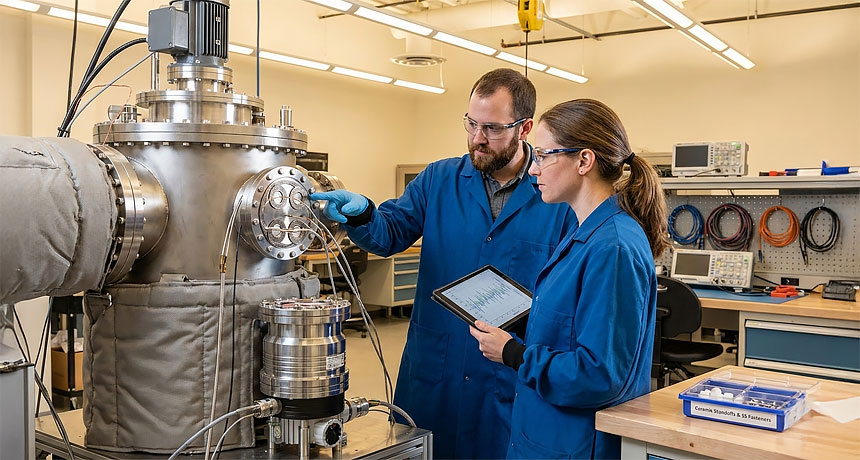
Choosing the Right Materials for High-Temperature Vacuum Applications
High-temperature vacuum work is unforgiving because it stacks multiple failure modes on top of each other. Elevated heat drives outgassing, accelerates diffusion and reactions, and magnifies any mismatch in thermal expansion. Meanwhile, vacuum removes convective cooling and eliminates the “forgiveness” of atmospheric contamination—so a material that behaves perfectly well in air can become a major source of background gas, particulates, or seal failure in a hot vacuum environment. Choosing materials thoughtfully up front is one of the most cost-effective ways to protect base pressure, process repeatability, and hardware longevity.
What “high-temperature vacuum” really means
“High temperature” can mean very different things depending on the system:
- Bakeout temperature: heating the chamber to drive off water and volatiles to reach lower pressure and cleaner surfaces.
- Process temperature: the operating temperature during deposition, heat treatment, degassing, or testing.
- Localized hot zones: heaters, sources, boats, filaments, crucibles, or furnace hot stages that run far hotter than the chamber wall.
A practical way to frame material selection is to define three temperatures: (1) the maximum chamber bakeout temperature, (2) the steady-state process temperature, and (3) any local peak temperatures at components (feedthrough tips, shields, fasteners near heaters). Many “mystery leaks” and contamination issues come from designing only around the chamber wall temperature while ignoring hot spots at seals, polymers, or electrical interfaces.
Core selection criteria for hot vacuum materials
Outgassing and vapor pressure
At high temperature, the priority is not only “low outgassing” in general, but also what species evolve and whether they interfere with your process. Water is a common culprit after exposure to ambient air; hydrocarbons and plasticizers are common with polymers and elastomers. In UHV and clean processes (thin films, surface science, electron/ion optics), even trace organics can be unacceptable.
Key practices:
- Prefer metals, ceramics, and glasses in the hot zone.
- Avoid hidden “soft” materials (adhesives, potting compounds, lubricants, marker ink, tapes).
- Specify cleaning and handling requirements (ultrasonic cleaning, solvent compatibility, glove handling, sealed storage).
Mechanical strength, creep, and thermal fatigue
High temperature reduces yield strength and promotes creep (slow deformation under load). Bolted joints can relax, springs can lose force, and flanges can distort. Thermal cycling adds fatigue, especially where geometry creates stress risers.
Ask:
- Will the component see constant load at temperature (clamps, bolts, spring contacts)?
- Will it cycle from ambient to hot repeatedly?
- Are there thin sections that warp or buckle?
Thermal expansion mismatch
Thermal expansion mismatch is a common root cause of cracked ceramics, leaking viewports, and misaligned assemblies. Even if two materials are “vacuum compatible,” they may not be thermally compatible when heated together.
Mitigation options:
- Use compliant features (bellows, flexures, spring washers designed for temperature).
- Choose matched CTE pairs for ceramic-to-metal joints.
- Isolate hot components mechanically from sensitive interfaces.
Chemical compatibility with process gases and byproducts
Hot vacuum often isn’t inert. Oxygen, hydrogen, water vapor, halogens, sulfur species, plasma environments, and metal-organic precursors can attack materials that would otherwise be stable.
Examples:
- Halogens and some plasma chemistries can be harsh on many metals.
- Hydrogen at elevated temperature can cause embrittlement in susceptible alloys.
- Oxidizing environments at temperature can rapidly scale some alloys and contaminate processes.
Define the full chemistry: process gases, cleaning gases, expected byproducts, and any accidental exposures (venting with humid air, maintenance solvents).
Common material choices and where they fit best
Stainless steels for chamber structures
For many high-vacuum systems, stainless steel remains the workhorse because it’s weldable, widely available, and compatible with standard vacuum hardware. Austenitic grades (often selected for vacuum) can be finished well, cleaned effectively, and baked to support demanding pressure targets.
Best practices for hot vacuum use:
- Favor low-carbon grades or stabilized grades where appropriate to support welding and reduce sensitization issues.
- Use good surface finishes (mechanically polished or electropolished where needed).
- Minimize trapped volumes (virtual leaks) by thoughtful design, vented screws, and proper weld geometry.
Nickel-based alloys for higher temperature strength
When temperatures climb and mechanical stability becomes a primary concern, nickel-based alloys are frequently selected for fixtures, hot-zone hardware, and components that must retain strength at elevated temperature. Alloys such as Inconel-family materials are common where stainless loses stiffness or creeps too readily.
Use cases:
- High-temperature furnace internals
- Spring elements and high-load fasteners (when properly specified)
- Components near heaters or thermal sources
Trade-offs:
- Higher cost and sometimes more challenging machining
- Material availability and lead times may be longer
- Surface condition and cleaning still matter for contamination control
Refractory metals for extreme hot zones
If your application includes very high local temperatures (sources, boats, shields near filaments), refractory metals like molybdenum and tungsten become attractive due to high melting points and good high-temperature behavior in vacuum.
Considerations:
- They can oxidize aggressively if exposed to air at temperature—procedures for venting and cooldown matter.
- Joining methods, machining, and brittleness considerations can complicate design.
- They are best reserved for the hot zone where their performance is needed.
Aluminum and copper: special cases
Aluminum is popular in some vacuum applications for weight, machining, and thermal conductivity, but it generally demands more caution at higher temperatures due to lower strength at temperature and potential distortion in hot service.
Copper offers excellent thermal conductivity and is valuable for heat spreading, thermal straps, and certain gaskets. However, copper is relatively soft and can creep under load at temperature, so mechanical design needs to respect that.
Seals and gaskets under heat
Sealing is often the first thing to fail in high-temperature vacuum.
Metal seals for high-temperature bakeouts
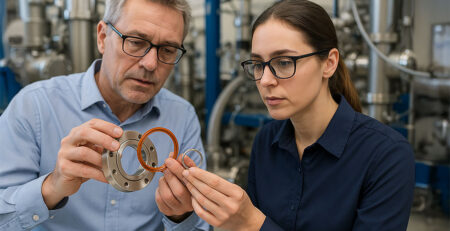
For high-temperature bakeouts and UHV, all-metal sealing approaches are typically preferred. Knife-edge metal gasket systems (such as CF-style hardware) are widely used because they tolerate higher bakeout temperatures than elastomers and reduce permeation concerns.
Practical notes:
- Plan for proper torque practices and flange condition management.
- Choose gasket materials that match your temperature and cycling needs.
- If you must cycle frequently at high temperature, consider gasket options intended to reduce oxidation and improve resealing behavior.
Elastomers: use carefully and keep them cool
Elastomer O-rings can be viable in many systems, but high heat is their enemy. Temperature capability varies with compound and exposure time, and outgassing/permeation can be limiting even before outright thermal damage occurs.
If elastomers must be used:
- Keep them out of the hot zone with thermal standoffs, water-cooled flanges, or heat shields.
- Use vacuum-baked or pre-conditioned O-rings when appropriate.
- Design for fast replacement and routine inspection rather than “set and forget.”
Electrical insulation, feedthroughs, and internal supports
Ceramics and glass-ceramics
Ceramics such as alumina are widely used for electrical insulation in hot vacuum because they remain stable at high temperature and have very low outgassing when properly processed. They are common in feedthroughs, standoffs, and insulators.
Key design point: ceramics are strong in compression but brittle—avoid bending loads and accommodate differential expansion at joints.
High-performance polymers: limited but useful
Polymers like PEEK and similar high-performance plastics can be useful in moderate-temperature vacuum regions (brackets, connector bodies, non-hot-zone supports), but they must be treated as temperature- and cleanliness-limited options. Even when the bulk material can tolerate heat, vacuum performance can be limited by absorbed water and evolving volatiles unless conditioning and bakeout practices are excellent.
As a rule: use polymers only where they are truly necessary, keep them away from the hottest zones, and validate performance with a bakeout and residual gas assessment when contamination risk is high.
Surface finishing, cleaning, and coatings
At high temperature, surface condition can matter as much as bulk material selection.
- Electropolishing and high-quality mechanical finishing can reduce surface area and help with cleaning.
- Passivation and controlled processing can improve corrosion resistance and surface stability.
- Vacuum firing (for certain components) can reduce hydrogen and volatile content.
Coatings can help in specific roles (wear surfaces, emissivity control, diffusion barriers), but they can also introduce adhesion risks, flaking/particles, and unexpected outgassing. Any coating used in a hot vacuum environment should be vetted for temperature stability and vacuum cleanliness.
A practical material selection workflow
- Define the envelope: bakeout temperature, process temperature, hot spots, number of thermal cycles, target pressure regime, and contamination sensitivity.
- Map materials by zone: “hot zone” (highest temperature), “warm zone,” and “cool zone” (seals, connectors, polymers).
- Choose sealing strategy early: metal seals vs elastomers drives flange types, maintenance procedures, and allowable temperatures.
- Verify chemistry compatibility: process gases, cleaning steps, and venting scenarios.
- Design for expansion and serviceability: avoid rigid constraints across dissimilar materials; ensure maintainable access to seals and consumables.
- Validate with a bakeout test: if possible, perform a controlled bakeout and confirm pressure behavior and contamination performance.
Conclusion
Choosing the right materials for high-temperature vacuum applications is ultimately about controlling outgassing, maintaining mechanical integrity through thermal cycles, and preventing chemical or particulate contamination that can undermine pressure and process performance. By defining your true temperature environment (including hot spots), selecting metals and ceramics where possible, using appropriate sealing strategies, and designing for thermal expansion and serviceability, you can build systems that pump down faster, stay cleaner, and operate more reliably. If you’d like help selecting materials, seals, or hardware for your specific bakeout and process conditions, contact the experts at High Vac Depot—they can help you match the right components to your temperature, vacuum level, and application requirements.





Leave a Reply
You must be logged in to post a comment.