


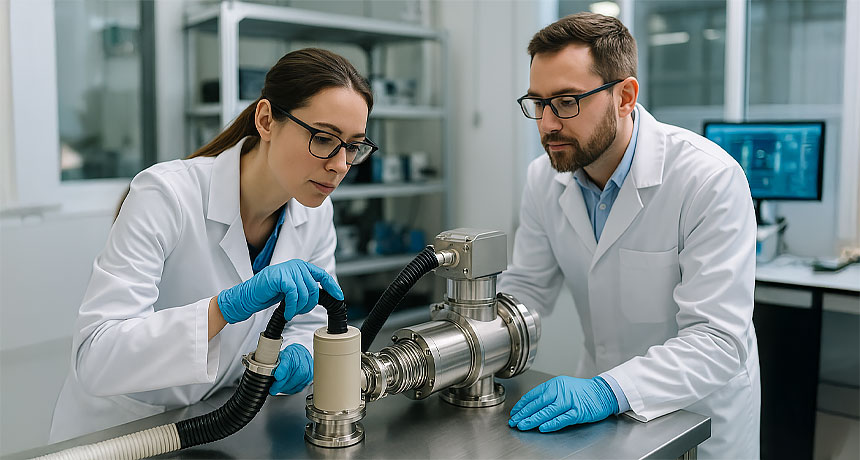
How Outgassing of Polymers Affects Vacuum Systems
In high-vacuum and ultra-high-vacuum (UHV) environments, the presence of even trace amounts of gas molecules can affect the performance, accuracy, and longevity of your equipment. While many engineers focus on leak tightness and pump efficiency, one less obvious—yet equally critical—factor is outgassing. This phenomenon is especially important when working with polymers inside a vacuum chamber or system.
Polymers, whether in seals, gaskets, insulation, wiring, or structural components, can release trapped or absorbed gases over time. If unmanaged, this outgassing can compromise vacuum quality, extend pump-down times, contaminate sensitive processes, and even damage equipment. In this article, we’ll explore what polymer outgassing is, why it matters, which polymers are most prone to it, and best practices for minimizing its impact in your vacuum systems.
What is Outgassing?
Outgassing refers to the release of gas molecules from a solid or liquid material into its surrounding environment—especially under vacuum conditions. In polymers, outgassing typically originates from:
- Absorbed atmospheric gases that slowly desorb when pressure drops.
- Volatile additives or plasticizers used during polymer manufacturing.
- Residual solvents or monomers left from processing.
- Decomposition products from chemical or thermal breakdown of the polymer.
The rate and volume of outgassing depend on factors like polymer chemistry, temperature, vacuum level, and the component’s surface area.
Why Outgassing is a Problem in Vacuum Systems
- Extended Pump-Down Times – The pump must remove outgassed materials before reaching the target vacuum level, slowing system readiness.
- Pressure Instability – Continuous outgassing can create fluctuations in chamber pressure, problematic for processes like semiconductor lithography.
- Contamination – Volatiles can condense on critical surfaces such as optics or wafers, degrading performance.
- Reduced Pump Efficiency – Certain vapors may be difficult to pump away completely, increasing load on cryopumps or turbomolecular pumps.
- Measurement Errors – Outgassed vapors can skew readings from mass spectrometers or RGAs.
Common Polymer Materials and Their Outgassing Characteristics
| Polymer Type | Typical Outgassing Level | Common Uses in Vacuum Systems | Notes |
|---|---|---|---|
| PTFE (Teflon) | Low | Seals, gaskets, insulation | Excellent chemical resistance; still outgasses fluorocarbon fragments at high temps. |
| PEEK | Low–Moderate | Structural parts, insulators | High strength, stable under moderate heat; pre-baking recommended. |
| Kapton (Polyimide) | Very Low | Electrical insulation, flexible circuits | Excellent for high-vacuum; minimal volatiles when baked. |
| Viton (Fluoroelastomer) | Moderate–High | O-rings, seals | Widely used but must be degassed; high water absorption possible. |
| Silicone Rubber | High | Seals, adhesives | High permeability and volatile content; poor choice for UHV. |
| Epoxy Resins | Variable | Adhesives, potting compounds | Outgassing depends on formulation and cure; low-outgassing grades available. |
Outgassing Testing and Standards
Industry often uses NASA’s ASTM E595 standard to evaluate materials for space and vacuum use. It measures:
- Total Mass Loss (TML) – Percentage of weight lost from a sample when exposed to vacuum and heat.
- Collected Volatile Condensable Materials (CVCM) – Percentage of volatile material that condenses on a cold surface.
For high-vacuum and UHV applications, materials with TML ≤ 1.0% and CVCM ≤ 0.1% are generally preferred.
Factors That Influence Polymer Outgassing
- Vacuum Level – Lower pressures accelerate desorption of trapped gases.
- Temperature – Higher temperatures can drive off volatiles more quickly but risk thermal degradation.
- Surface Area – Larger exposed polymer surfaces release more gas.
- Moisture Content – Water vapor is a major contributor to outgassing; humidity control is critical before system operation.
- Age and Wear – Older or degraded polymers often release more contaminants.
Best Practices to Minimize Outgassing in Vacuum Systems
1. Material Selection
Choose low-outgassing polymers like PTFE, PEEK, or polyimide whenever possible. Use manufacturer data or standards like ASTM E595 to guide choices.
2. Pre-Bake Components
Heating polymer components under vacuum before installation helps drive off volatiles. Bake temperatures should be within the polymer’s thermal tolerance.
3. Humidity Control
Store polymer parts in a dry environment and handle them in low-humidity conditions to reduce water vapor load.
4. Use Metal Where Possible
When feasible, replace polymer components with metal parts—especially in critical UHV applications.
5. Surface Treatments
Coatings or encapsulation can reduce the direct exposure of polymers to the vacuum environment, lowering outgassing rates.
6. System Design Considerations
Position polymers away from line-of-sight to critical optical, electronic, or deposition surfaces to minimize contamination risks.
Real-World Example: Semiconductor Fabrication
In semiconductor production, polymer components like O-rings and cable insulation are unavoidable. However, fabs manage outgassing by:
- Using low-outgassing grades of Viton for seals.
- Pre-baking critical components before chamber integration.
- Employing nitrogen purges to displace moisture before pump-down.
- Monitoring vacuum purity with RGAs to detect contamination early.
The result is a stable, clean vacuum that supports high-yield manufacturing.
Conclusion
Polymer outgassing is an often-overlooked but critical factor in maintaining high-vacuum and ultra-high-vacuum performance. By understanding the mechanisms behind it, selecting materials wisely, and implementing strategies like pre-baking and humidity control, engineers can prevent contamination, reduce downtime, and extend equipment life.
The experts at High Vac Depot can help you evaluate materials, design low-contamination systems, and troubleshoot vacuum quality issues caused by outgassing. Contact us today for expert advice, tailored solutions, and a full range of high-vacuum components designed to keep your systems clean, stable, and efficient.



Leave a Reply
You must be logged in to post a comment.