PLEASE NOTE: Due to global tariffs, prices may fluctuate. To better serve you, we reserve the right to add a surcharge to orders.

Industry Articles

How Cold Cathode Gauges Work in High Vacuum Applications

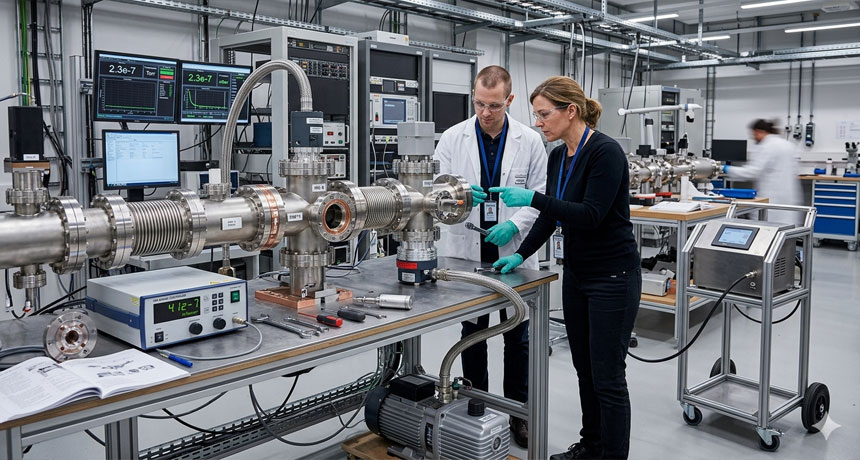
Cold cathode gauges are widely used in high vacuum applications because they provide durable, filament-free pressure measurement in ranges where mechanical and thermal-conductivity gauges are no longer effective. They are common in vacuum chambers, coating systems, research equipment, analytical instruments, semiconductor support systems, and other applications where users need to know what is happening well below rough vacuum.
Read more...

The Most Common Sources of Vacuum Leaks

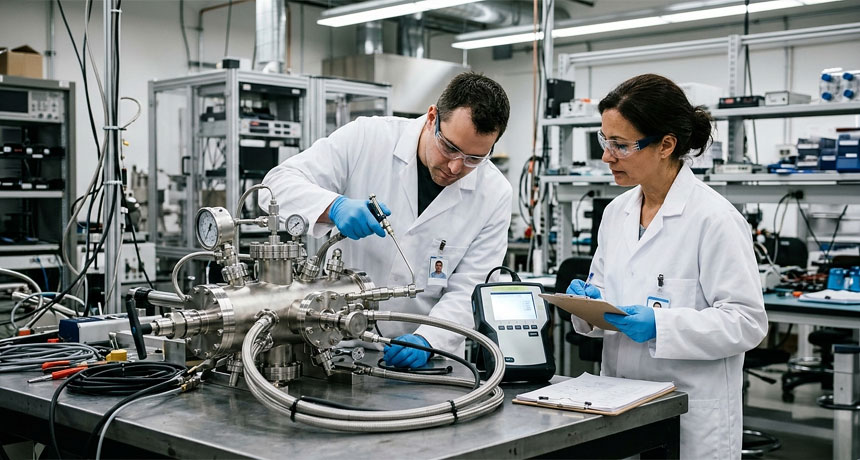
Vacuum leaks are one of the most common and frustrating problems in vacuum-system work. A system may have the right pump, clean hardware, and a sensible layout, but a small leak can still keep it from reaching base pressure, slow the pump-down curve, or create unstable readings during operation. In some cases, the leak is obvious. In others, the system behaves poorly even though every connection looks fine from the outside.
Read more...

Why Calibration Matters for Vacuum Sensors

Vacuum sensors are often treated like small accessories in a larger vacuum system, but they have an outsized influence on how that system is operated. A pump may be healthy, a chamber may be clean, and the plumbing may be leak-tight, but if the sensor is drifting or reading outside its useful range, the operator can still make the wrong decision. In vacuum work, pressure readings are not just numbers on a display. They guide pump-down decisions, process timing, leak...
Read more...

The Role of Backstreaming in Vacuum Contamination

In vacuum work, contamination problems are often blamed on the obvious suspects: leaks, dirty parts, bad materials, or poor cleaning. Those are all real causes. But one contamination source is easy to underestimate because it can come from inside an otherwise functional pumping system: backstreaming.
Read more...

The Use of Vacuum in High-Energy Physics Research

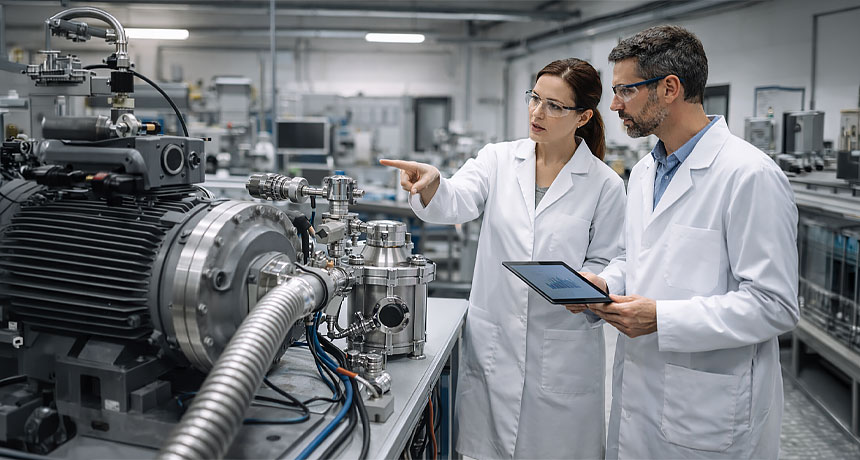
High-energy physics research depends on vacuum for a simple reason: particle beams do not behave well in air. Whether the work involves a large accelerator, an experimental beamline, a detector test stand, or an instrument-development lab, the goal is the same. Researchers need a controlled environment where charged particles can travel long distances, collide where intended, and be measured without unnecessary interference.
Read more...

Why Stainless Steel is the Gold Standard for Vacuum Chambers

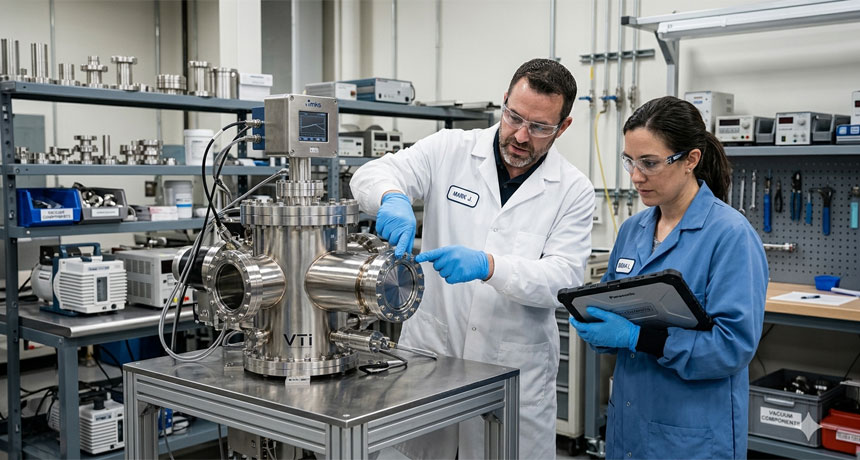
In vacuum engineering, material choice is never a cosmetic decision. The chamber wall is part of the vacuum system itself: it influences outgassing, leak integrity, chemical compatibility, mechanical stability, cleaning, and long-term reliability. While aluminum, glass, and specialty alloys all have their place, stainless steel has earned its reputation as the gold standard for vacuum chambers because it delivers the best all-around balance of cleanliness, strength, fabricability, and compatibility across a wide range of vacuum regimes.
Read more...

How to Design a Leak-Free Vacuum System

“Leak-free” in vacuum engineering usually means two things: (1) no real leaks to atmosphere (or between isolated volumes), and (2) no hidden gas sources inside the system that behave like leaks (virtual leaks, permeation, outgassing, backstreaming, and trapped volumes). Most vacuum “leak problems” are actually a mix of design choices, assembly practice, and material behavior—so the best time to solve them is at the design stage, not after the system is built. This guide walks through a practical, engineering-first approach...
Read more...

Can a Vacuum Pump Be Too Powerful for an Application?

A vacuum pump can absolutely be “too powerful”—not because it pulls too much vacuum (vacuum is bounded by physics and leaks), but because it can pull too much pumping speed and throughput for the system’s conductance, process behavior, and control needs. Oversizing often wastes money, increases operational risk, and can actually make results less stable. The goal is not “the biggest pump,” but the right effective pumping speed at the chamber—and the right level of control over pressure, gas load,...
Read more...

Comparing Oil-Sealed vs Oil-Free Vacuum Pumps

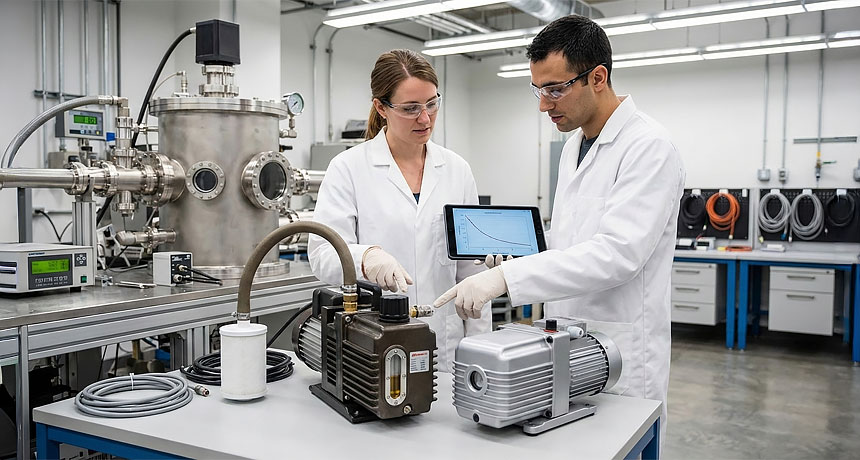
Choosing between an oil-sealed (wet) pump and an oil-free (dry) pump is one of the most consequential decisions in a vacuum system design. It affects everything downstream—base pressure stability, contamination risk, maintenance workload, uptime, and even how forgiving the system is to water vapor and process byproducts. The “right” answer depends on how clean your process must be, how much vapor you expect, what pressure range you need, and what kind of lifecycle cost you can tolerate. This article breaks...
Read more...

Choosing the Right Materials for High-Temperature Vacuum Applications

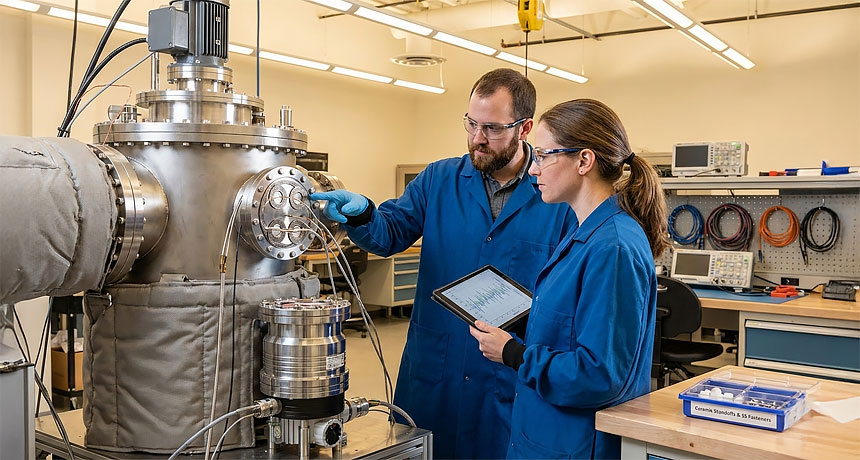
High-temperature vacuum work is unforgiving because it stacks multiple failure modes on top of each other. Elevated heat drives outgassing, accelerates diffusion and reactions, and magnifies any mismatch in thermal expansion. Meanwhile, vacuum removes convective cooling and eliminates the “forgiveness” of atmospheric contamination—so a material that behaves perfectly well in air can become a major source of background gas, particulates, or seal failure in a hot vacuum environment. Choosing materials thoughtfully up front is one of the most cost-effective ways...
Read more...

"*" indicates required fields

This field is for validation purposes and should be left unchanged.
I would like to request a quote for the following product:
This field is hidden when viewing the form
Anything else we need to know? Make, model, or other details.
Name*
Shipping Address*
A shipping address is required to receive a quote so we can more easily provide you with the best price possible.