


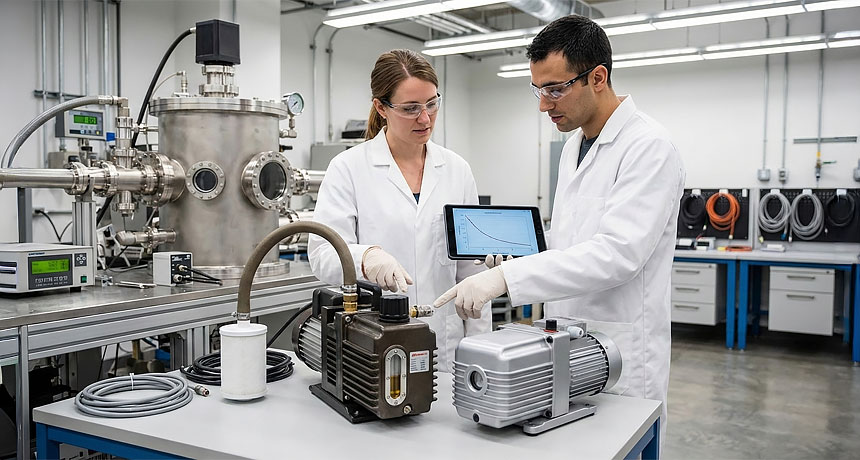
Comparing Oil-Sealed vs Oil-Free Vacuum Pumps
Choosing between an oil-sealed (wet) pump and an oil-free (dry) pump is one of the most consequential decisions in a vacuum system design. It affects everything downstream—base pressure stability, contamination risk, maintenance workload, uptime, and even how forgiving the system is to water vapor and process byproducts. The “right” answer depends on how clean your process must be, how much vapor you expect, what pressure range you need, and what kind of lifecycle cost you can tolerate.
This article breaks down how oil-sealed and oil-free vacuum pumps differ, where each excels, and how to make an engineering-first selection that holds up in real facilities.
How oil-sealed and oil-free pumps create vacuum
Oil-sealed pumps
Oil-sealed pumps use oil as part of the pumping mechanism—typically for sealing, lubrication, and heat management. The most common examples are rotary vane pumps, which you’ll see across laboratories, R&D environments, and industrial vacuum systems. In many setups, these are selected as robust roughing pumps and as backing pumps for high-vacuum stages. For an overview of oil-sealed rotary vane options, see High Vac Depot’s Rotary Vane Pumps collection.
Because oil is integral to performance, oil condition directly impacts ultimate pressure, pumping speed consistency, and cleanliness.
Oil-free pumps
Oil-free pumps avoid oil in the compression chamber. Common “dry” options include dry scroll and diaphragm pumps, each with different strengths:
- Dry scroll pumps are popular for clean applications that still need respectable ultimate pressure in the rough-to-medium vacuum range. Explore High Vac Depot’s Dry Scroll Pumps selection.
- Diaphragm pumps are often chosen for corrosive or condensable vapors, especially where oil contamination is unacceptable. See Diaphragm Pumps for common configurations.
Dry pumps reduce the risk of oil backstreaming into the system, but they often trade that advantage for different maintenance needs and sensitivity to particulates or process chemistry.
Performance: ultimate pressure, pumping speed, and system behavior
Ultimate pressure and where it matters
Oil-sealed rotary vane pumps can deliver very low ultimate pressures in the rough vacuum regime, making them a strong choice when you need a deep roughing baseline before transitioning to high-vacuum pumping stages. Dry scroll pumps can also achieve low pressures for many lab processes, but performance depends heavily on tip seal condition, operating temperature, and gas load.
If you’re sizing pumps based on “how fast will we get there,” it helps to think in terms of conductance and effective pumping speed at the chamber—not just nameplate numbers. High Vac Depot’s article on vacuum level and pumping speed is a helpful reference for system-level thinking.
Stability under real-world gas loads
Real systems don’t pump clean, dry air. Water vapor, solvents, reaction products, and backfilled gases all change how a pump behaves. Oil-sealed pumps can be very tolerant of mixed loads when operated correctly (including proper use of gas ballast), but they can also suffer rapid oil degradation if vapors condense into the oil.
Dry pumps avoid oil contamination by design, but they may be more sensitive to particulate ingestion and may require different service intervals based on tip seals, valves, or diaphragms.
Cleanliness and contamination risk
Oil backstreaming and process sensitivity
In processes where surface cleanliness matters—thin films, electron/ion optics, plasma tools, and many analytical instruments—oil contamination is often a primary concern. Oil backstreaming (oil vapor migrating upstream) and oil aerosols at the exhaust can contribute to both chamber contamination and facility air-quality issues if not managed.
When oil-sealed pumps are the right tool, the standard mitigation strategy is proper exhaust filtration and good operating practice. High Vac Depot offers multiple options in Maintenance Products – Filters, including items like Edwards Exhaust Mist Filters designed to capture oil mist at the outlet.
Dry pumps and “clean by default” expectations
Oil-free pumps are often selected specifically because the process cannot tolerate hydrocarbons. That said, “oil-free” does not automatically mean “maintenance-free” or “contamination-proof.” Dry pumps can still generate particles (for example, from wear components) and can still move process byproducts through the system. If the process is highly sensitive, the entire vacuum train—valves, traps, gauges, and plumbing—should be selected with cleanliness and compatibility in mind.
Maintenance and ownership cost
Oil-sealed maintenance: predictable, but frequent
Oil-sealed pumps require an oil management plan:
- Regular oil changes based on hours, gas load, and contamination
- Monitoring for discoloration, odor changes, and particulate content
- Ballast use and warm-up practices to reduce condensation
- Exhaust filtration inspection and replacement
In exchange, oil-sealed pumps are often mechanically robust, rebuildable, and forgiving—especially in general-purpose roughing.
Oil-free maintenance: fewer fluids, more wear-part attention
Oil-free pumps shift the maintenance burden from oil to wear parts:
- Dry scroll pumps may require periodic seal replacement and cleaning
- Diaphragm pumps may need diaphragm and valve service kits
- Some dry designs are sensitive to dust/particles and may benefit from inlet filtration depending on the application
The upside is a cleaner process environment and less risk of oil-related failures (such as oil contamination after a severe vapor event). The downside is that maintenance may be more specialized, and performance can degrade in ways that are less obvious until you check ultimate pressure and pumpdown time.
Vapor handling, condensables, and chemical compatibility
Water vapor and condensables
Condensables are one of the biggest differentiators in the real world. Oil-sealed pumps can ingest water vapor, but if vapor condenses into the oil, it can emulsify and compromise both lubrication and vacuum performance. Proper operating temperature, ballast use, and oil-change discipline become critical.
Dry pumps can be attractive when condensables are unavoidable, but compatibility depends on the pump type. Diaphragm pumps are commonly used in chemistry applications because they can better tolerate aggressive vapors without contaminating oil.
Process chemistry
If your process involves reactive gases, oxygen exposure at elevated flow, solvents, acids, or corrosives, material compatibility matters. Pump choice is not just “wet vs dry” but also “what materials are in the compression path?” and “what does the pump do with byproducts?”
A useful conceptual framework is described in High Vac Depot’s older but still relevant discussion of wet versus dry pumps, which helps clarify how sealing/lubrication approaches relate to application fit.
Noise, vibration, and facility considerations
Oil-sealed rotary vane pumps often have a familiar industrial sound profile and can transmit vibration through benches and frames if not isolated. Dry scroll pumps are frequently chosen for lower vibration and cleaner operation in lab spaces, though acoustic profiles vary by model and installation.
Exhaust handling also differs. Oil-sealed pumps may require filtration and thoughtful exhaust routing for a clean workspace, while dry pumps may still benefit from exhaust management depending on process gases.
How to choose: a practical selection workflow
Step 1: Define the process requirements
- Required base pressure and acceptable background contamination
- Gas load (continuous vs intermittent)
- Vapor/condensable content and cleaning/venting procedures
- Sensitivity to hydrocarbons or particulates
Step 2: Match the pump type to the dominant risk
- If hydrocarbon contamination is unacceptable, prioritize dry technologies (often dry scroll or diaphragm).
- If the environment is general-purpose and cost sensitivity is high, oil-sealed rotary vane pumps remain a strong default for many roughing needs.
Step 3: Engineer the accessories, not just the pump
A “good pump” can underperform in a poorly designed vacuum train. Consider:
- Inlet traps or filters where appropriate
- Proper exhaust filtration for oil-sealed pumps
- Correct valving and gauge placement for reliable operation and troubleshooting
If you need system-level help—especially when the application has competing requirements—High Vac Depot’s Consulting team can help you select a configuration that fits your pressure targets, gas loads, and maintenance expectations.
Conclusion
Oil-sealed and oil-free vacuum pumps each solve real problems, but they do so with different tradeoffs. Oil-sealed pumps often provide strong rough vacuum performance with rugged, proven mechanisms—at the cost of oil management and contamination controls. Oil-free pumps reduce hydrocarbon risk and can simplify cleanliness in sensitive applications, but they shift maintenance toward wear parts and can be more sensitive to particulates or chemistry. The best choice comes from defining your true process requirements, identifying your dominant risk (contamination, vapors, maintenance capacity, or cost), and building a complete vacuum solution—not just buying a pump. If you’d like help selecting the right pump type (and the right supporting components) for your application, reach out through High Vac Depot’s Contact Us page and their team will help you spec a solution that performs reliably in the real world.








Leave a Reply
You must be logged in to post a comment.