


Metal Seals vs Elastomers
Elastomer seals are typically used in gas loads because they don’t require any compression to seal. However, the sealing performance depends on the pressure it takes to create a leak-tight seal. Metal seals are made by compressing the metal material to achieve a leak-tight seal at atmospheric pressures or less.
Testing
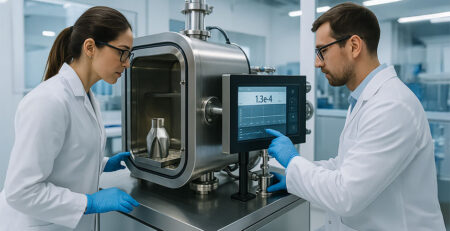
To test the elastomer and metal seals, a vacuum load was made using a chamber made from Aluminum and two glass bell jar. Two identical heatsinks were used to conduct heat away from a 60 W light bulb placed at the bottom of the chamber after being covered with an insulator. The heatsink was attached with metal screws on all four corners; it was also connected via metal bands to ensure no movement. The bell jar has a metal bottom to maintain the pressure and keep the heat from escaping from its walls.
Two elastomer seals were inserted in each chamber. One of them was made with a mixture of rubber, Nitrile, and chloroprene, and another with an elastomer called Neoprene that is more resistant to heat than Nitrile. The metal seals were made by compressing a stainless steel rod to be more rigid than steel. The metal balls holding the rods were placed in separate chambers; one was made from Aluminum and another from stainless steel. A metal rod was used to conduct the heat from the bottom of the room.
The metal seals were placed in each chamber and pressed down by forceps until their metal balls touched the glass jar. A light bulb was attached at the bottom of its compartment, and a thermometer was inserted into it to measure the temperature. It is essential to have an accurate reading for each seal because sealing performance may not be consistent for all types of elastomer, especially Nitrile and Neoprene. Describing the test results is a challenge because there was no accurate way to measure the pressures within each chamber. The exact amount of force needed to create a seal depends on the type of elastomer and metal used.
The results indicate that elastomer seals can be more efficient than metal seals. The average temperature for the glass bell jar with elastomer seals was around 60 degrees Celsius, while the temperature for the glass bell jar with metal seals was around 100 degrees Celsius. The heat spreads through the material faster when metal is used instead of elastomers.
The choice of material that should be used depends on seal strength and the best price-to-performance ratio or pressure range. Each type of seal has its advantages and disadvantages; however, it is essential to note that metal seals are more challenging to create because they require a lot of force and pressure for a leak-tight seal.
Metal Seals vs. Elastomers
Metal seals usually require less force to create a leak-tight seal, whereas elastomeric seals require more energy. The pressure needed to create a leak-tight seal can be measured by the amount of power required, depending on the type of seal and material. Elastomeric seals have frictionless properties.
Elastomers are materials that do not deform with pressure; they are most likely shaped in a dome or diamond shape.
Metal seals are shaped like cubes or disks made of stainless steel or iron; they are typically used when you need to contain pressurized gases, such as combustion gases in an automotive compressor or power plant, or even for medical purposes such as suction tubes for surgical procedures.
The seal used depends on the particular application, material choice, and cost. A vacuum seal is most likely needed in areas where you need a high-performance seal, or you need to contain high-pressure levels, where the risk of leaks is more significant due to high temperature and pressure.
Gas Capacity in Metal vs. Elastomer
The gas capacity depends on how much gas can be stored within a cavity before it becomes pressurized. It is measured by Specific Gravity (SG), which tells how much material it takes to hold a specific weight/volume of a particular fluid. The specific gravity of 1.0 is needed for a perfect vacuum, where there is no gas for the seal to contain.
In a metal seal, the cavity size changes when pressurized with gas. Metal seals are made of porous materials and are usually more resistant to heat than elastomeric seals. They also have a lower risk of leaks in high-vacuum conditions as it has higher gas capacity due to their ability to retain gases through their pores, which creates a leak-tight seal at low pressures.
A metal seal has a higher cost as it is more expensive to manufacture; however, its pressure resistance is better than an elastomeric seal because it doesn’t require much force or increased pressure at low temperatures. This can be used when dealing with precision applications, such as high-pressure injection and carbon dioxide systems.
Metal seals are more reliable than elastomeric seals at high temperatures because of their ability to withstand extreme heat and pressure; however, elastomers are more efficient at high temperatures because elastomers can withstand a significant amount of heat without losing their capability.
Cold containment, vacuum seals, and pressure-sensitive adhesive specialist Surtec™ are investigating alternative elastomers as cold sealants.
Various materials are used for the fabrication of vacuum sealers. They can come with different parts included in their design. Some of these parts transfer the heat from the source to the next position, while others are used to apply pressure to the appropriate location.
Vacuum sealers can be powered by various motor drives depending on their purpose. The power requirements vary depending on the needs and applications, determining the type of motor needed. Efficient engines convert heat into motion which helps to ensure that action is not wasted during non-vacuum operations and also helps to minimize energy consumption when there is no vacuum present.
In a typical metal seal, the elastomer is the main component of the elastomeric seal, typically made of silicone, Nitrile (NBR), Neoprene, and combinations. The gas in a metal seal is usually air or oil, as they both have lower vapor pressure than other gases. Elastomers can also be filled with inert gases like argon or krypton to improve a vacuum. Vacuum greases are used to lubricate the seals and create a good contact between the seals and the surface under a vacuum.
Conclusion
Elastomeric seals are capable of being more efficient than metal seals. The average temperature for the glass bell jar with elastomer seals was around 60 degrees Celsius, while the temperature for the glass bell jar with metal seals was around 100 degrees Celsius. The heat spreads through the material faster when metal is used instead of elastomers.
High Vac Depot can supply your company with all kinds of quality services and products and offers efficient vacuum solutions that meet industrial and research needs. And as always, you can contact the experts at High Vac Depot for fast, free answers to your industrial or research questions! Get in touch with us today!




Leave a Reply
You must be logged in to post a comment.