


Ion Pumps
They rely on the sputtering of getter materials located inside a series of cells and through the implantation, or burial, of the ions produced.
As such, it reflects noble gas ions as neutral particles with much higher energy than titanium.
During operation, the gas molecules pumped by chemisorption and physisorption become permanently bound and are no longer able to contribute to the chamber’s pressure.
Finally, the triode. The configuration of the triode is different to the CV and DI in that the rings are actually grounded, and it uses negative voltage titanium rings as the cathode.
Under ideal conditions, ion pumps are capable of reaching pressures as low as 10−11 mbar.
A collector plate at anode potential is positioned behind the cathode.
This makes them highly effective, quiet and low maintenance.
An Ion pump is one of the typical pumps used to generate ultra- and extreme- high vacuum.
Tantalum is an extremely hard, high atomic mass material.
Pumping relies on the sputtering of getter materials inside a series of cells and by the implantation or burial of the ions produced.
In the case of the CV/Diode pump, the cathode material is made of titanium.
Ion getter pumps require a large magnetic field within an isolated chamber and use high voltages to pull electrons into the assembly.
But over time titanium atoms will build up on these rings, creating some whiskers and reducing the space between the rings and the vacuum wall, introducing electrical instability.
The titanium cathode will react with getterable gases which can be pumped by chemisorption (e.g. N2, O2, H2, CO, CO2 water vapour and light hydrocarbons).
Also, this pump is accumulating type and exhausts independently without an fore pump during normal operation. This pump is widely used in analytical instruments and accelerators.
Ion getter pumps (also called sputter ion pumps or simply ion pumps) produce ultra-high vacuum (UHV) without the aid of moving parts or valves.
Often the inner wall of the pump vessel serves as the third electrode (at grounded potential).
Ion Pumps
An ion pump (also referred to as a sputter ion pump) is a type of vacuum pump which operates by sputtering a metal getter. Under ideal conditions, ion pumps are capable of reaching pressures as low as 10−11 mbar.[1] An ion pump first ionizes gas within the vessel it is attached to and employs a strong electrical potential, typically 3–7 kV, which accelerates the ions into a solid electrode. Small bits of the electrode are sputtered into the chamber. Gasses are trapped by a combination of chemical reactions with the surface of the highly-reactive sputtered material, and being physically trapped underneath that material. Ion pumps are commonly used in ultra-high vacuum (UHV) systems. In contrast to other common UHV pumps, such as turbomolecular pumps and diffusion pumps, ion pumps have no moving parts and use no oil. They are therefore clean, need little maintenance, and produce no vibrations. These advantages make ion pumps well-suited for use in scanning probe microscopy and other high-precision apparatuses.
-
Pumps
Gamma Titan 100L Ion Pump
$5,280.00$5,016.00Select options This product has multiple variants. The options may be chosen on the product pageQuick View -
Pumps
Gamma Titan 1200LX Ion Pump
Starting at: $15,279.00Starting at: $13,890.00Select options This product has multiple variants. The options may be chosen on the product pageQuick View -
Pumps
Gamma Titan 200L Ion Pump
$7,507.50$7,132.13Select options This product has multiple variants. The options may be chosen on the product pageQuick View -
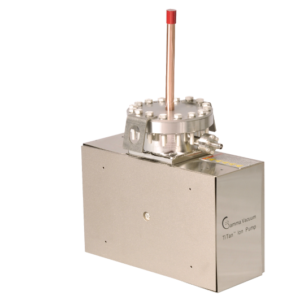


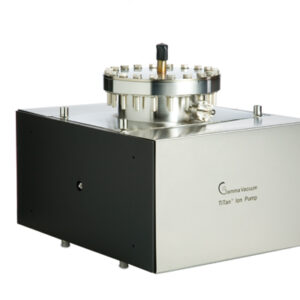
An ion pump first ionizes gas within the vessel it is attached to and employs a strong electrical potential, typically 3–7 kV, which accelerates the ions into a solid electrode.
Gasses are trapped by a combination of chemical reactions with the surface of the highly-reactive sputtered material, and being physically trapped underneath that material.
Small bits of the electrode are sputtered into the chamber.
As a result, pumping speed and stability are higher.
For the DI/Noble Diode pumps, instead of titanium, the cathode material is made of tantalum.
In solving problems with ion pumps, it may be helpful to review information on how they work and normal operating procedures.
The gas molecules pumped by chemisorption (gettered) and physisorption (ions) are now permanently “bound” and not able to “contribute” to the pressure inside the chamber.
This gives much higher implantation depth in the electrodes and physisorption (trapping).
Ion Pumps (Sputter-Ion Pumps, Getter-Ion Pumps, Penning Pumps) provide a clean, simple, low maintenance alternative for producing and maintaining high and ultra-high vacuum.
An ion pump (also referred to as a sputter ion pump) is a type of vacuum pump which operates by sputtering a metal getter.
Since it has a simple operating principle which is that an electric field is applied to a cell (pump cell) consisting of an anode and a cathode, there is no driving part, and no sound or vibration is generated.
Ion pumps make use of a large magnetic field within an isolated chamber and use high voltages to pull electrons into the assembly.
The main difference between conventional, differential and triode pumps is the cathode material used.
Non-reactive noble gases are pumped mainly by ion implantation, which is why CV/Diode pumps have a significantly reduced pumping speed for noble gases.